
If you smell gas, do this first
A gas appliance is not a do-it-yourself problem when the odor appears. Nothing on this page replaces these steps.
Leave the building
Walk out with everyone in the home, including pets. Do not stop to open windows or look for the source.
Do not touch switches
Skip light switches, garage door openers and phones inside the home. A spark is all it takes.
Call from outside
Call your gas utility or 911 from a neighbor's yard or the street. They will tell you when it is safe to go back in.
Call a plumber after
Once the utility clears the home, call us and we can inspect the heater, the gas connection and the vent.
Do not relight a pilot or reset a gas appliance that you suspect is leaking. Gas line safety is licensed plumbing work.
The yearly maintenance schedule at a glance
This table sorts the jobs by who should do them. Your manual overrides it if the manufacturer says otherwise.
| Task | How often | Who does it |
|---|---|---|
| Clean the inlet filter screen | Every 6 to 12 months | Homeowner, with the water off |
| Flush the heat exchanger with descaler | Yearly, more often in very hard water | Homeowner with isolation valves, or a plumber |
| Inspect vent pipe and termination | Yearly | Plumber, or a careful visual check |
| Check gas connection and burner | Yearly | Licensed plumber only |
| Test the carbon monoxide alarm | Monthly | Homeowner |
How to flush a gas tankless heater
Flushing dissolves the scale that builds inside the heat exchanger. You need a small submersible pump, two hoses, a bucket and a descaling solution. White vinegar works on many models, but check what your manufacturer allows.
- Turn off the power and gas. Shut the gas valve on the unit and unplug it or switch off its power. Let the unit cool.
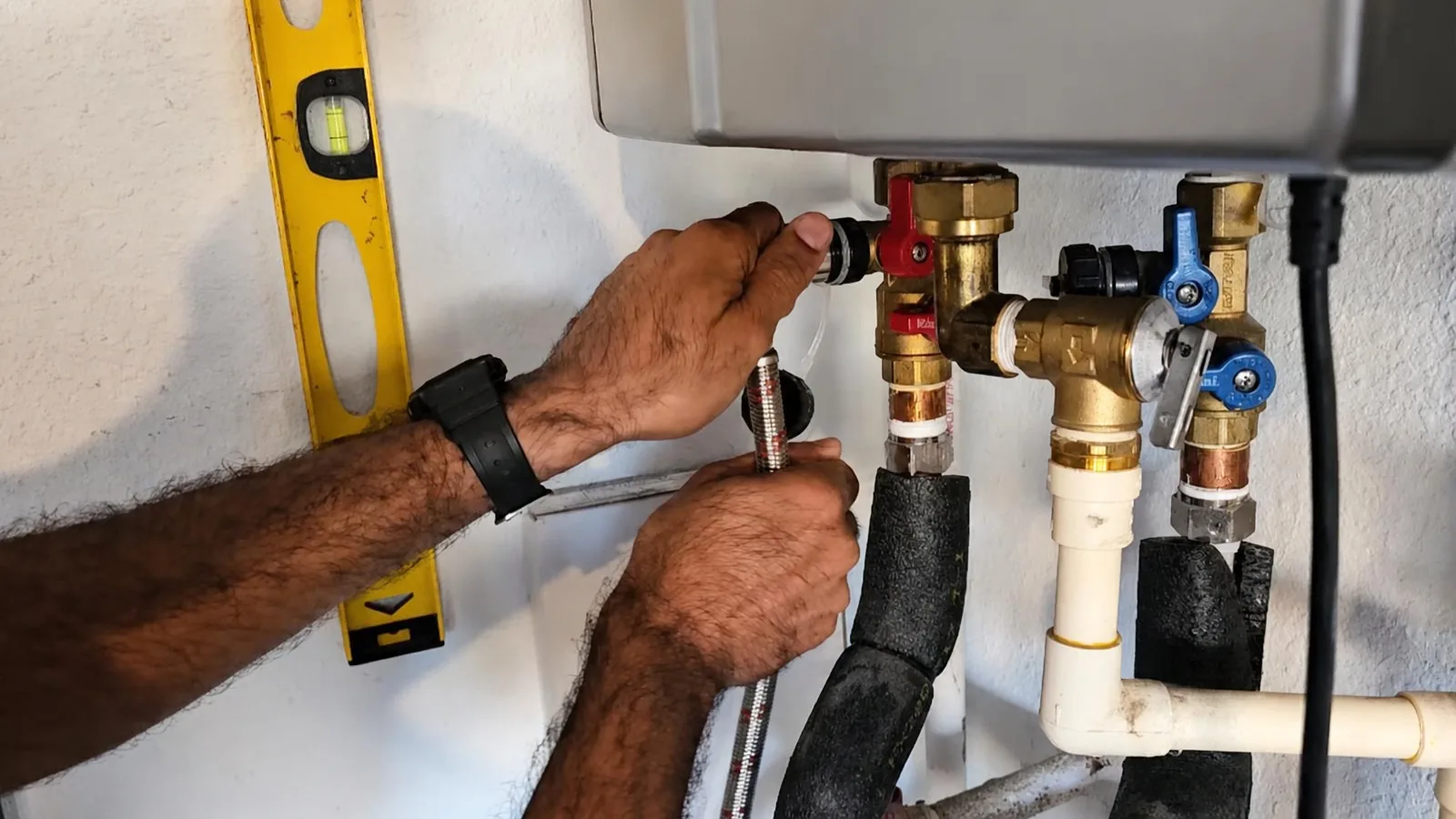
- Close the water valves. Shut the cold inlet and the hot outlet isolation valves. If the heater has none, a plumber can add them, and that makes every future flush easier.
- Connect the hoses. Attach one hose from the pump to the cold service port and the other from the hot port back to the bucket.
- Fill the bucket and run the pump. Use about 3 to 4 gallons of descaler and let it circulate for 45 minutes to an hour.
- Rinse well. Drain the bucket, run fresh water through the unit and open the cold inlet to flush the lines.
- Reopen everything and test. Open all valves, restore gas and power and run a hot tap to confirm normal heat.
If the unit has no service ports at all, do not cut into the plumbing yourself. A plumber can set up the valves in one visit.
Due for a yearly service?
Call and ask for a maintenance visit on your gas tankless heater. Same-day appointments are offered when available, and you get a clear price before work starts.
Why Goleta's hard water makes this job matter
Heat drives dissolved minerals out of water and onto the hottest surface, which in a tankless heater is the inside of the heat exchanger. The result is scale that narrows the passages and blocks heat transfer. The heater then burns longer for the same hot water and may shut down on an overheat code.
Goleta Water District's 2025 water quality report gives a customer average of 21 grains per gallon, and the district itself calls the water very hard. In water like that, an annual flush is the minimum. Households that skip it often see the first symptoms as lukewarm water, long waits for heat or a heater cycling on and off.
Venting and gas connections on a tankless unit follow the manufacturer's instructions and the California Plumbing Code, which is built on the Uniform Plumbing Code (UPC).
The inlet filter screen
A small mesh screen sits where cold water enters the heater. It catches sand, flakes of pipe scale and bits of debris so they do not jam the flow sensor or water valve. A clogged screen shows up as weak hot water pressure while the cold side runs fine.
To clean it, close the inlet valve, relieve the pressure at a hot tap, unscrew the filter cap and pull the screen. Rinse it under a tap with a soft brush, then check for holes before reseating it. Replace a torn screen rather than reusing it.
Vent and combustion air checks
The vent carries exhaust out of the building, and a gas heater depends on it. Look for loose joints, brown stains, rust streaks, sagging runs and anything blocking the outdoor termination, such as leaves, a bird nest or stored items. Keep the combustion air path around the unit clear too.
Many modern units are condensing models that vent through plastic pipe and drain acidic condensate. The condensate drain and its neutralizer need to stay clear, or the unit may lock out. A vent that looks damaged or a heater that smells of exhaust needs a plumber, and a working carbon monoxide alarm nearby is the safety backstop.
What error codes usually mean
Codes differ by brand, so your manual is the real key. In general they fall into a few families.
Ignition or flame codes
The burner did not light or lost its flame. Causes include a closed gas valve, a dirty flame rod or low gas supply.
Vent or airflow codes
The unit sees a blocked exhaust or poor combustion air. Check the termination and the vent run.
Overheat or scale codes
Water is leaving too hot or the exchanger is restricted. Scale is a common cause, and a flush is the first step.
Flow or sensor codes
The heater cannot detect enough flow to fire. A clogged screen, a closed valve or a failed sensor can all do it.
Write the code down, power the unit off for a minute and restart it once. If the same code returns, repeated resets can mask a real fault, so call for water heater repair.
What you can do and what needs a plumber
Homeowner care and licensed work have a clear line, and it follows the gas.
Homeowner jobs
- Wipe and inspect the exterior and vent termination
- Clean the inlet filter screen
- Flush the heat exchanger when isolation valves exist
- Test the carbon monoxide alarm
Licensed plumber jobs
- Anything involving the gas connection or burner
- Vent repairs and rerouting
- Replacing sensors, valves or the heat exchanger
- Adding isolation valves or a condensate neutralizer
The California Contractors State License Board lists gas appliances and water heating equipment under the C-36 plumbing classification, which is why gas work stays with a licensed plumber. A maintenance visit also shows whether the unit is a candidate for tankless water heater service or is near the end of its life.
Goleta and Santa Barbara County notes for tankless heaters
Permit rules vary, so ask City of Goleta Building and Safety before replacing or moving a gas water heater inside city limits. In the unincorporated areas, including Isla Vista and Eastern Goleta Valley, ask County of Santa Barbara Building and Safety.
Goleta Water District says the local supply is very hard and treats filters and softeners as a customer choice. A softener cuts scale at the source and gives a tankless heater the longest service life. Routine maintenance such as flushing and screen cleaning does not need a permit question, but gas line changes do.
Questions we hear most
Once a year is the usual manufacturer guidance. In very hard water, some homes need it every six months. If the unit throws overheat codes or hot water turns lukewarm, flush it sooner.
Many manufacturers allow white vinegar, and others sell their own descaler. Check your manual before you pour anything into the unit. Run the solution for the time the manual states and rinse thoroughly afterward.
Leave the building right away and call your gas utility or 911 from outside. Do not use switches or phones in the home. Call a plumber only after the utility confirms it is safe.
Permit rules vary, so ask City of Goleta Building and Safety if your home is inside the city. For Isla Vista and other unincorporated areas, ask County Building and Safety. A maintenance flush does not change the installation, but any gas or vent change usually does.
Try one restart after writing the code down. If it returns, stop resetting. Repeated resets can hide a vent, flame or flow problem, and a gas appliance with an unresolved fault should be looked at by a plumber.
Yes, but less scale builds up. The inlet screen, the vent and the burner still need a yearly check, and the softener itself needs its salt and settings kept up.