
Sewage is backing up: what to do first
A broken sewer line leaves nowhere for waste to go. These steps limit damage until the plumber arrives.
Stop all water use
Every flush, shower and load of laundry adds to what is already trying to come up. Tell everyone in the building to wait.
Find the outdoor cleanout
A capped pipe near the foundation, usually 3 or 4 inches wide, is the access point. Do not open it if it is full, because the pressure can spray sewage.
Check the neighbors
If a neighbor on the same street is also backing up, the blockage may be in the street main. Skip ahead to the district backup contacts below.
Protect what you can
Lift rugs, move electronics and shut off power to wet areas if you can reach the panel safely. Photograph the damage for your insurance.
Sewage carries bacteria, so avoid bare-hand contact and keep children away until the area is cleaned. The plumber clears or isolates the line first and cleanup decisions come after.
Signs the pipe is broken, not just clogged
A clog usually clears and stays clear for a while. A broken pipe does not. Repeated backups after cleaning, a gurgle in the toilet when you run water elsewhere, and a sewage smell in the yard all point to a pipe problem. A patch of green, wet lawn above the line, or a sinking spot in the driveway, can mean waste is leaking into the soil.
The most common causes are roots entering at joints, an offset where two pipe sections no longer line up, a belly where the pipe sags and holds water, and cracks from age or ground movement. A camera shows which one it is. A sewer camera inspection is how the plumber decides between a cleaning, a patch and a replacement.
The Goleta West Sanitary District reported in its fall 2018 newsletter that camera inspections found sewer defects primarily from root intrusion. That is a district main, but the same roots reach private laterals through the same kinds of joints.
Repair options for a failed lateral
The right fix depends on where the damage is and what lies above it. This table lays out the usual choices.
| Option | How it works | Good fit | Watch for |
|---|---|---|---|
| Spot repair | Dig to the break, cut out the bad section, join new pipe | One short failed section | Other weak spots nearby |
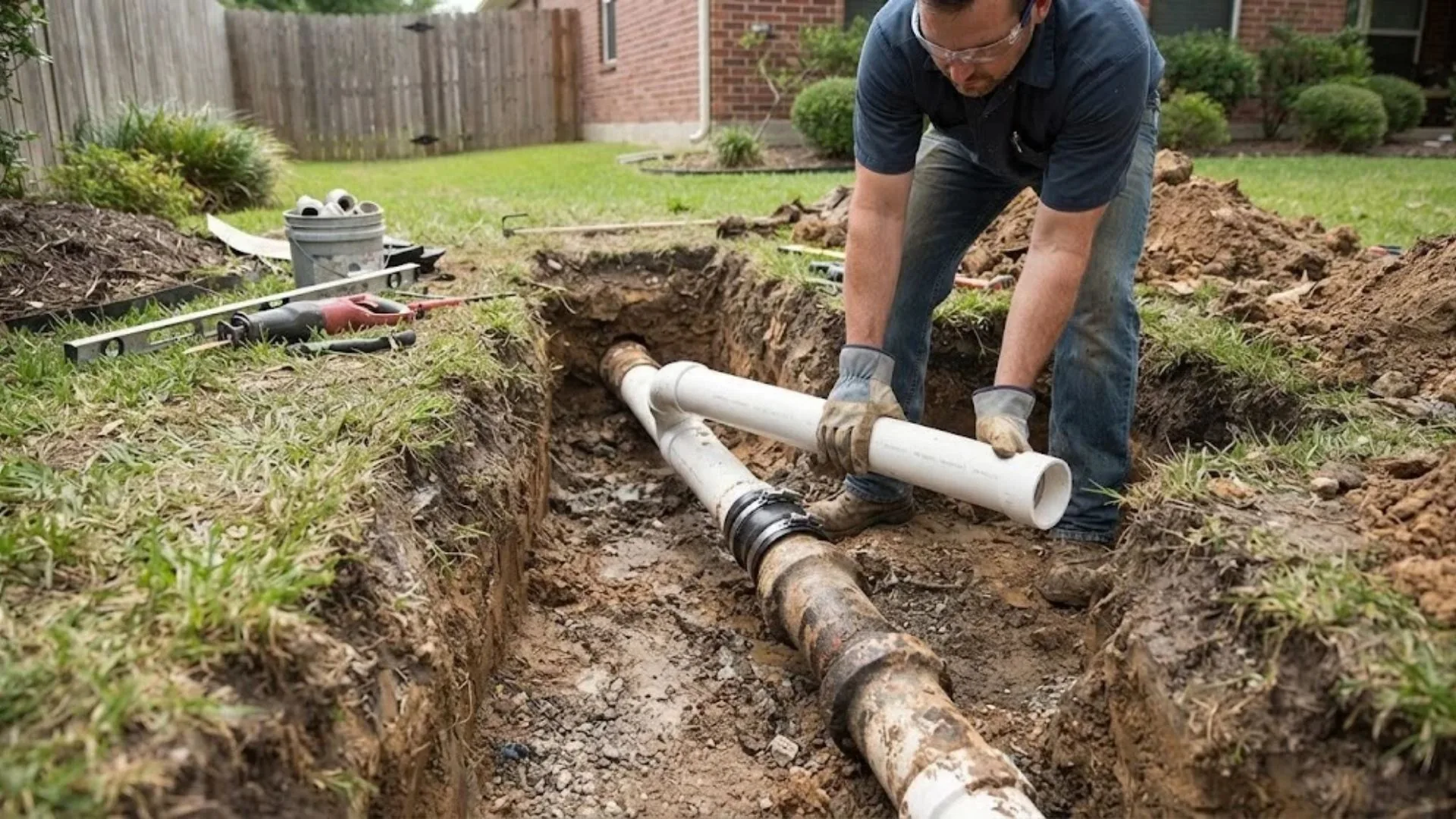
| Full replacement by trench | Remove the old lateral and lay new pipe at the right slope | Collapsed, offset or badly rooted lines | Surface restoration |
| Pipe bursting | Pull new pipe through the old one, breaking it outward | Long runs under driveways or landscaping | Needs entry pits and district approval |
| Pipe lining | Cure a resin liner inside the old pipe | Sound pipe with small cracks | Not District approved for laterals in Goleta Sanitary District |
| Under-slab repair | Cut the slab, repair or reroute the pipe | Drain failure beneath the floor | Slab patching, possible rerouting |
Whose pipe is it? Lateral, easement and the district
Goleta Sanitary District's FAQ page says the property owner maintains the lateral from the building to the street main. It also says a district permit is needed for work outside the property line or inside a district easement. Two districts collect sewage in this area, Goleta Sanitary District and Goleta West Sanitary District, so ask yours which one serves your address.
If a cleanout shows waste standing in the lateral, the repair is a private job and the owner pays. If the main in the street is the problem, the district handles it. When a main backs up, the same FAQ lists a district backup line and an after-hours line for Goleta Sanitary District customers, and Goleta West Sanitary District customers should ask that district for its own.
Also ask City of Goleta Building and Safety, or County Building and Safety in unincorporated areas, whether your repair needs a plumbing permit. Permit rules vary, so confirm before the dig starts.
Pipe lining: confirm with your district before you choose it
Trenchless lining feels like the easy answer, because it avoids digging up a yard. Goleta Sanitary District's FAQ states that a liner is "not a District approved method of repair" for the lateral. That is the district's own wording, and it applies to homes inside its service area.
So do not accept a quote for lining a lateral until your district confirms in writing that it allows it for your address. A repair the district will not accept can mean doing the work twice. If lining is off the table, sewer line cleaning can buy time while a spot repair or replacement is planned.
Spot repair versus full replacement
Many owners ask whether they can fix only the broken piece. Sometimes yes. This compares the two paths.
Spot repair
- Best when the camera shows one failed section and the rest of the pipe is sound
- Smaller excavation, shorter job and lower surface restoration
- Leaves old pipe in place, so another section may fail later
Full lateral replacement
- Best for collapsed, offset or root-filled pipe along most of its length
- New 4-inch pipe at a consistent slope removes the belly
- Larger dig or a bursting method, with surface work and a district permit if it reaches the street
A plumber with camera footage can usually say which path fits. If the footage shows damage at several joints, replacement often costs less over time than repeated spot repairs.
What changes the price of a sewer line repair
No two sewer repairs cost the same, which is why we give a clear price before work starts and not a number over the phone. These are the factors that move it.
Standard homeowner policies often exclude sewer line failure from wear or roots. Some offer a sewer backup endorsement or a service line rider. Check your policy before work starts and ask what documentation your insurer needs.
If the property is on septic, not a public sewer
Not every property in the area is on a public sewer. If yours is not, the rules come from Santa Barbara County, not a sanitary district. Under County Chapter 18C, a permit is required to construct, repair, modify, abandon or destroy a septic system.
Routine maintenance by a qualified contractor does not need a permit, but a written report must be filed within 30 days. The owner is responsible for inspections and for fixing violations. If the home is near Montecito, Montecito Sanitary District runs a Septic to Sewer conversion program with an installment plan, so ask whether your street qualifies before paying for a major septic repair.
Repair and what comes before it
Most repairs start with a camera, then a cleaning to clear the line, then the fix. Hydro jetting before the camera run can help, but only if the pipe is sound enough to take the pressure. If the problem began as a slow drain, drain cleaning is the usual first call.
A broken sewer line under a slab can also leak into the floor structure. If you see damp flooring or cracks without a clear source, ask about leak detection in the same visit.
Questions we hear most
Yes. The line is staffed 24/7, so a sewage backup on a holiday weekend is dispatched like any other call. Tell the dispatcher which fixtures are backing up and whether sewage is on the floor.
A repair that needs a district permit or a dig may be scheduled as the next step once the plumber has stopped the backup.
Check whether the outdoor cleanout is full. If it is full, the blockage is downstream, possibly in the main. If it is empty and fixtures still back up, the problem is in your house line. If neighbors have the same issue, call the district.
Goleta Sanitary District's FAQ states that a liner is not a district-approved method of repair for the lateral. Confirm with your own district before choosing lining. We can show you what repair options the camera findings support.
Santa Barbara County's Chapter 18C requires a permit to repair or modify a septic system, and routine maintenance needs a report filed within 30 days. The owner is responsible. The dispatcher can tell you whether your repair is septic or sewer work.
Permit rules vary, so ask City of Goleta Building and Safety, or County Building and Safety if you are in an unincorporated area. Work outside the property line or in an easement also needs a district permit.
The property owner maintains the lateral from the building to the street main, according to Goleta Sanitary District's FAQ. A clogged lateral may need replacement at owner cost. Ask your insurer whether a sewer rider applies.
Yes. A property manager can call the 24/7 line with the address and the unit affected. The plumber confirms who approves the work before any repair starts.