
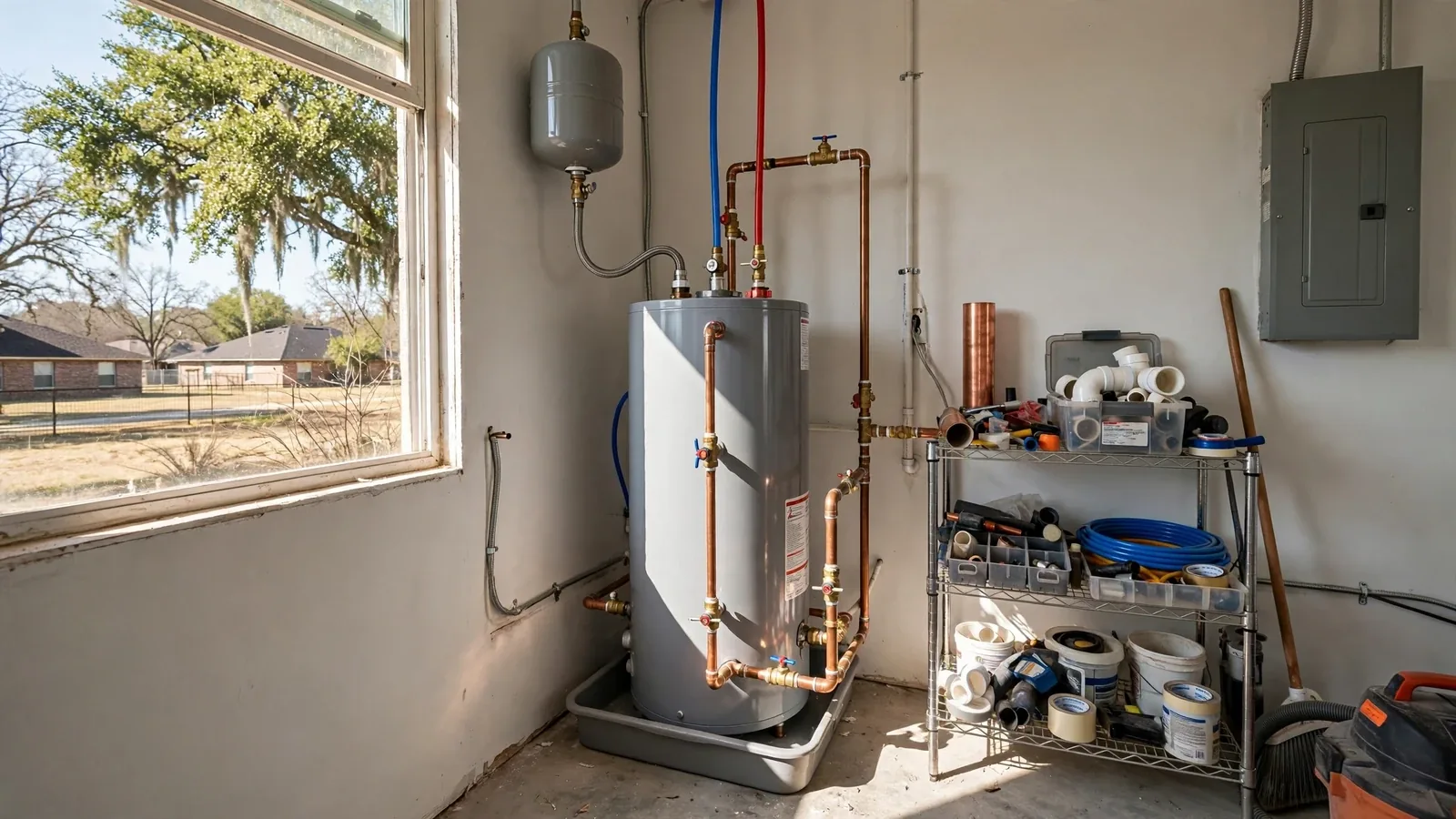
What a proper installation includes
Installing a water heater involves more than bolting a tank into a corner. It covers the water connections, the gas or electric supply, a vent or exhaust path, a temperature and pressure relief valve, and a safe place for that valve to drain.
The California Plumbing Code sets minimum requirements for these parts, and a plumber follows it so the heater is safe on the first day and the tenth year. Parts a buyer rarely sees on a quote, such as the discharge pipe, are the ones inspectors and insurers notice. If the old unit failed unexpectedly, the same work is done faster on the water heater replacement page.
Tank, tankless or heat pump: choosing the type
Each type has a different footprint, fuel need and price range.
| Type | Strengths | Watch for |
|---|---|---|
| Gas tank | Quick recovery, works during power cuts if the pilot is standing | Needs a vent path and gas line |
| Electric tank | Simple install, no venting | Needs a 240-volt circuit and slower recovery |
| Heat pump tank | Uses far less electricity | Needs airflow, a condensate drain and a 240-volt circuit |
| Tankless gas | Endless hot water, small wall footprint | Larger gas line, venting and yearly descaling, see tankless service |
A clean install, step by step
The order of work matters. This is what a careful install looks like.
- Walk the site. The plumber measures the space, checks the gas line size, the electric panel and the route for venting and drainage.
- Isolate and remove. Water, power and gas are shut off. The old heater is drained and taken out.
- Set the new unit. The tank goes on a level base with a drain pan where required and is strapped to the wall studs.
- Connect water and fuel. New shutoff valves and flexible connectors go on, then the gas line or the 240-volt circuit.
- Fit the safety devices. The relief valve and its discharge pipe go in, with an expansion tank if the system has a check valve.
- Test and show you. Leaks, gas joints, venting and temperature are tested. You get shown the shutoffs.
The code-driven parts to expect on a quote
These items are easy to leave off a low estimate, then show up as extras. Ask whether each one is included.
Expansion tank
When a water meter has a check valve or a pressure reducing valve, heated water has nowhere to expand. A small expansion tank, often 2 gallons, absorbs it and protects the tank and relief valve.
Shutoff valve
A full-port ball valve on the cold line lets you stop the water in an emergency. Old gate valves often seize.
Relief valve and discharge pipe
The relief valve opens before pressure or heat gets dangerous, and a solid pipe carries the discharge to a safe spot. It should never be capped.
Drain pan and strapping
A pan under the tank catches slow leaks, and Health and Safety Code 19211 requires strapping on new and replacement heaters up to 120 gallons with an off-the-shelf kit.
Gas heaters add venting and a gas shutoff. If you smell gas at any point, leave the building and call your gas utility or 911 before calling a plumber.
Where the heater goes: garage, closet or outside
The location sets the rules. A garage needs the burner raised or protected on gas units, and the heater needs a pan. A closet needs combustion air and a vent path. An outside wall suits tankless units, though the exhaust still needs clearance from windows.
In Old Town Goleta along Hollister Avenue and in apartments near UC Santa Barbara, space is tight and a heater often sits in a closet. Measure the closet door too, since a new tank must fit through it. A tankless unit or a heat pump may suit the layout better than another standard tank.
What changes the price of an installation
Prices vary because jobs vary. We give you a clear price before work starts, and these are the things that move it.
A new heater is rarely an insurance matter, but a licensed install with a permit, where one is required, may matter later when you sell the home or file a claim. Keep the contract and invoice.
What to ask any plumber before you sign
These questions help you compare quotes fairly.
- Is the plumber licensed for this work? Look up the licence on the Contractors State License Board lookup. A number in an ad does not prove it is valid.
- Is there a written contract? A written contract is required over $500 and must name the licence and who pulls permits.
- How much is the down payment? State rules limit it to the lesser of $1,000 or 10 percent of the contract price, in most cases.
- Who pulls the permit? Permit rules vary, so ask City of Goleta Building and Safety, or County Building and Safety for unincorporated areas.
- Which code items are included? Expansion tank, pan, relief piping, straps and venting should be listed.
Sizing, hard water and what to do around the heater
Size by first-hour rating and household, not by what the last tank was. Two to three people often suit 40 gallons, and four or more usually want 50. The Goleta Water District report gives 21 grains per gallon, so consider a softener or filter to slow scale on the new unit.
If the install also changes pipe routes, the project may overlap with general plumbing installation or repiping work. Customers in Eastern Goleta Valley and Hope Ranch should confirm their permit authority with the county first.
Questions we hear most
A straightforward tank swap in the same spot often takes a half day. Moving the heater, adding venting or running a new circuit adds time. The plumber gives a realistic window when booking.
Match it to the household. Two to three people usually do well with 40 gallons, four or more with 50. Check the first-hour rating on the label.
Often yes. If a check valve or pressure reducing valve keeps heated water from flowing back into the main, the system needs somewhere for expansion. The plumber tests pressure and decides.
Yes for most. California Health and Safety Code 19211 requires new and replacement water heaters to be braced, anchored or strapped, for units up to 120 gallons that have an off-the-shelf strapping kit.
Sometimes. Tankless units often need a larger gas line and a different vent, so the plumber checks both. See the tankless water heater page for what to expect.
Use the Contractors State License Board lookup or call (800) 321-CSLB. Check the licence classification and status before you sign anything.
Yes. Property managers call the 24/7 line, which also books planned work, and the dispatcher schedules each address. Give the unit numbers, access details and fuel type.