
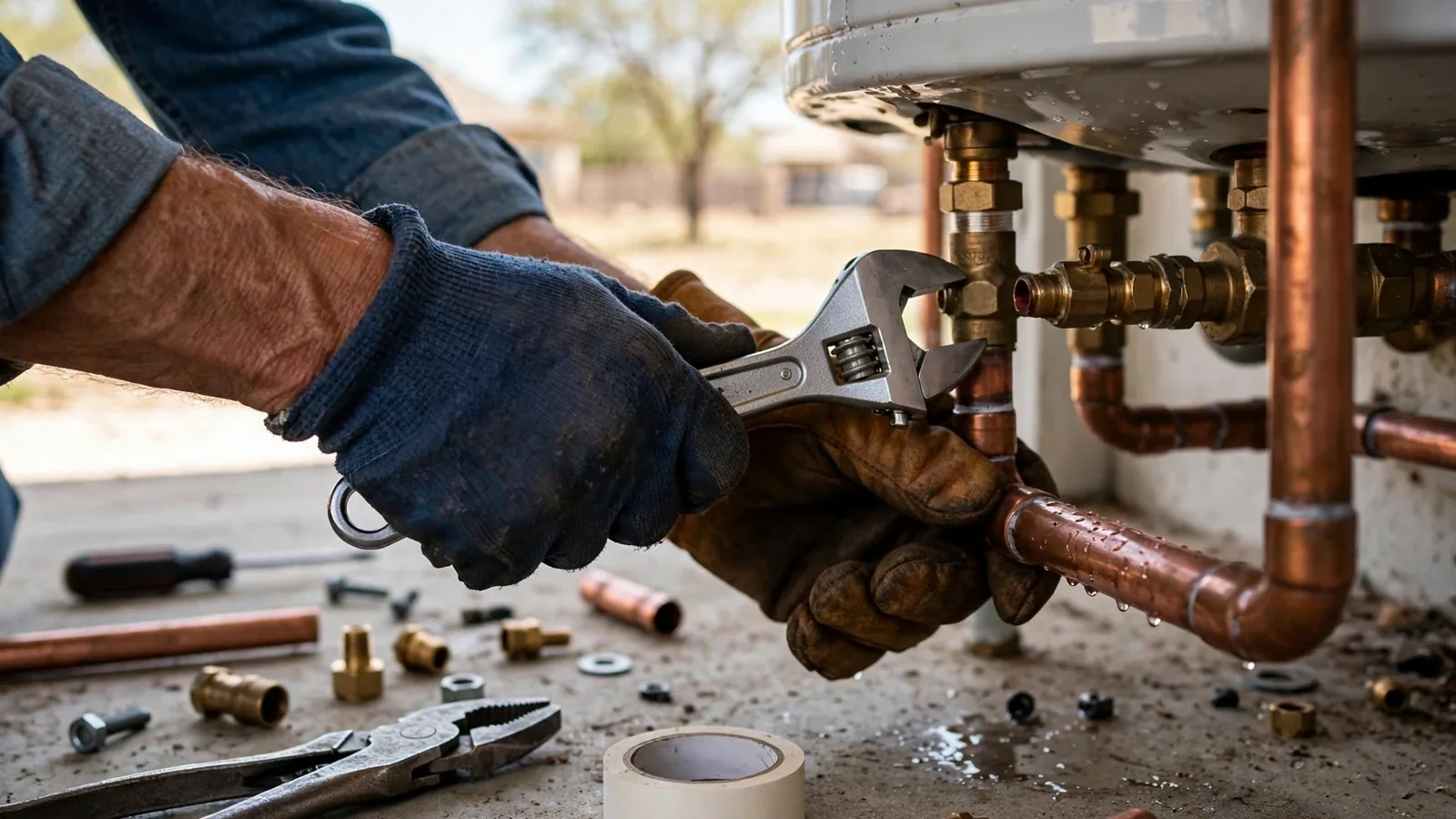
What to do right now: a leaking or dead water heater
Some heater problems can wait for a morning appointment. These four cannot, because water, power or gas is involved.
Water is pooling under the tank
Close the cold supply valve on the pipe entering the top of the heater and the leak slows or stops. Then turn off the power or gas so the unit does not fire into an empty or draining tank.
The relief valve is spitting or the pipe is hot
A discharge pipe running hot water means the tank is overheating or over-pressurized. Turn the heater off and call. Do not cap or plug the valve.
You smell gas or see scorch marks
Leave the building and call your gas utility or 911 before calling a plumber. Do not flip switches or light anything on the way out.
The garage or closet floor is wet and power is nearby
Cut the breaker for the heater and for any outlet on that wall if you can reach the panel dry. Move boxes and stored items off the floor.
Once the water is stopped, photograph the heater, its label and the wet area.
Where the leak is coming from decides the fix
Not every wet heater is a dead heater. The source of the water tells you whether this is a repair or a replacement.
Water at the base of the tank
Water that seeps from the bottom or from under the insulation usually means the steel tank has rusted through. That tank cannot be patched, and water heater replacement is the next step.
Drips at the pipe connections
Wet threads on the hot or cold nipples at the top are often a loose or corroded fitting. A new flexible connector or a re-sealed joint can end the leak.
Water from the relief valve
A valve that drips after each heating cycle may be reacting to high pressure or may be worn. Testing the pressure tells the plumber which one it is.
Wet insulation on the drain valve
A weeping brass drain valve is a small swap.
If you cannot find the source, leak detection separates a heater leak from a supply line hiding behind it.
If you have a gas water heater
Gas heaters add a risk that electric ones do not. These steps keep the first minutes safe.
- Smell gas? Get out first. Leave the building and call your gas utility or 911 before calling a plumber. Gas piping is not something to inspect yourself while the smell is present.
- Do not relight a pilot that keeps going out. A pilot that will not stay lit points to a thermocouple, a gas valve or a draft problem, and each of those needs testing.
- Look at the vent pipe. A loose, rusted or sagging flue lets exhaust spill into the room. Soot, a yellow flame or a scorched draft hood are all reasons to shut the unit off.
- Keep the area clear. Paint, cleaners and gasoline cans stored next to a burner can ignite or give off fumes. Move them away before the plumber arrives.
If gas is involved, the utility or 911 comes first.
No hot water: the quick checks
Start at the power. On an electric heater, check the double-pole breaker and press the red reset button on the upper thermostat, which trips when the tank overheats. On a gas heater, see whether the pilot light or the igniter display is on. A home with no hot water also loses showers, laundry and the dishwasher, so most of these calls are urgent.
If the breaker holds and the unit still runs cold, a failed element, thermostat or gas valve is the likely cause. These parts are repairable on a tank that is otherwise sound, and the plumber checks the tank for rust before spending money on them.
Relief valves, discharge piping and venting on a repaired heater should meet the California Plumbing Code, which is built on the Uniform Plumbing Code (UPC), so ask the plumber to check them before leaving.
Hybrid, electric and gas water heater repair
The fix depends on how the heater makes heat, so the plumber starts by reading the label. Each type fails in its own way, and each has its own tests.
Electric tank heaters
Most electric tanks use two 240-volt heating elements, one near the top and one near the bottom, each controlled by a thermostat. A dead lower element gives you a little hot water that runs out fast. A dead upper element usually gives none. The plumber tests resistance across each element with a meter and replaces the one that fails.
Gas tank heaters
A gas tank relies on a burner, a pilot or an electronic igniter, a thermocouple or flame sensor, and a vent. A thermocouple that has worn out will shut off gas as soon as you release the pilot button. A blocked flue or a dirty burner assembly causes soot and uneven heating.
Hybrid heat pump units
A hybrid unit pulls heat from room air with a compressor and fan, and falls back on electric elements when demand is high. Common faults are a clogged air filter, a blocked condensate drain, a fan that stops and a compressor that will not start.
Symptom, likely cause, likely fix
This table matches what you see to what the plumber usually finds.
| What you notice | Likely cause | Typical repair |
|---|---|---|
| Lukewarm water that runs out fast | Failed lower element or thermostat on an electric tank | Replace the element or thermostat |
| Rumbling or popping from the tank | Scale and sediment baked onto the bottom | Flush the tank and check the anode rod |
| Rusty hot water only | Anode rod used up and the tank wall corroding | Replace the rod if the tank is still sound |
| Water from the relief valve | High pressure or a worn valve | Test pressure, add an expansion tank or replace the valve |
Hard water, garages and closets in Goleta
Local conditions change what fails in a water heater and where it fails.
Very hard water
The Goleta Water District water quality report gives a customer average of 21 grains per gallon. Minerals bake onto elements and the tank floor, so elements burn out and sediment makes the tank noisy and slow to heat. A softener or filter slows that scale.
Anode rods work harder
The sacrificial anode rod corrodes in place of the tank wall. Hard, mineral-heavy water tends to use it up sooner, and a bare rod means the steel is next.
Garages and closets
In Old Town Goleta along Hollister Avenue and in rental homes near UC Santa Barbara, heaters often sit in a garage corner or a closet where a slow leak goes unseen. A drain pan and a glance each month catch it before the floor does.
What changes the price of a water heater repair
Two heaters with the same symptom can need very different work. We give you a clear price before work starts, and these are the things that move it.
Homeowner policies often cover sudden water damage from a burst or leaking tank, and usually exclude the heater itself when it fails from age. Photograph the damage and the heater label before anything is moved.
The seismic strapping check on a repair visit
California's Health and Safety Code 19211 requires new and replacement water heaters to be braced, anchored or strapped against earthquake motion, for units up to 120 gallons that have an off-the-shelf strapping kit. A repair is not a replacement, but loose or missing straps are easy to see during a visit. A tank that tips can tear its gas line or supply pipes.
The plumber can add straps and check that the gas connector is flexible. If the heater is near the end of its life, a failing tank and missing straps together tip the decision toward a replacement. If you would rather move the heater or change its type, that is a planned installation. A leak that is not the heater is a job for burst pipe repair, and callers from Isla Vista and Santa Barbara reach the same 24/7 line.
Questions we hear most
Yes. The line is staffed 24/7, so a leaking tank at 2 a.m. or on a holiday gets the same dispatch as a weekday call. Tell the dispatcher whether the heater is gas or electric and where the water is coming from.
Shut the cold supply valve and the power or gas control while you wait.
It depends on where the water comes from. A leak at a fitting, a drain valve or the relief valve is repairable. Water seeping from the bottom of the tank means the steel has failed, and the tank needs replacing.
On an electric heater, check the breaker and the red reset button on the upper thermostat. On a gas heater, check whether the pilot or igniter is lit. If both are fine, call.
Common causes are a tripped breaker, a failed element or thermostat, a pilot that will not stay lit and a failed gas control. Scale from hard water can burn out elements early.
Yes. Flushing clears sediment from the tank floor, and the plumber checks the anode rod and the relief valve in the same visit. With hardness around 21 grains per gallon in the Goleta Water District, a yearly flush is a reasonable habit.
Codes differ by brand and model, so read the label and the manual. Most point to ignition failure, a sensor fault, a venting problem or overheating. Give the dispatcher the code and model number and they can pass it to the plumber.
Yes. Property managers can call the same 24/7 line, give the unit address and say who will be on site.