
Right now: an overflowing or blocked toilet
Water on the bathroom floor makes the next few minutes matter. These four steps limit the damage before help arrives.
Close the shutoff valve
Turn the small oval handle on the wall or floor behind the bowl clockwise until it stops. If the bowl is still rising, lift the tank lid and push the rubber flapper down to stop more water entering.
Stop flushing
Each flush sends another 1.6 gallons or more toward a bowl that cannot empty. Repeated flushing is the most common way a simple clog becomes a flooded floor.
Protect the floor and the room below
Lay towels around the base and move rugs out. Water that reaches a subfloor or a ceiling below can soak drywall in an afternoon, so photograph it for your records.
Keep it clean
Overflow from a blocked toilet carries waste. Wear gloves, keep pets and children out, and skip the plunger if the bowl is full to the rim.
If you have no second toilet, say so on the call. We treat a lost only-bathroom as a same-day priority, and after hours the dispatcher will tell you what to do while the plumber is on the way.
Symptom, likely cause and usual fix
Most toilet calls fall into a handful of patterns. This table matches what you see to what is usually behind it.
| What you see | Likely cause | Usual fix |
|---|---|---|
| Bowl fills and will not drain | Clog in the trap or the closet bend | Auger the toilet, pull it if something is lodged |
| Water seeps around the base | Failed wax ring or loose bolts | Reset the toilet on a new wax ring |
| Toilet rocks side to side | Broken flange or uneven floor | Repair the flange, then reset and shim |
| Tank refills every few minutes | Worn flapper or chain too short | Replace the flapper, adjust the chain |
| Hissing that never stops | Failed fill valve | Replace the fill valve |
| Several drains gurgle or back up | Blockage in the main line | Drain cleaning on the main |
Leaks at the base, wax rings and loose bowls
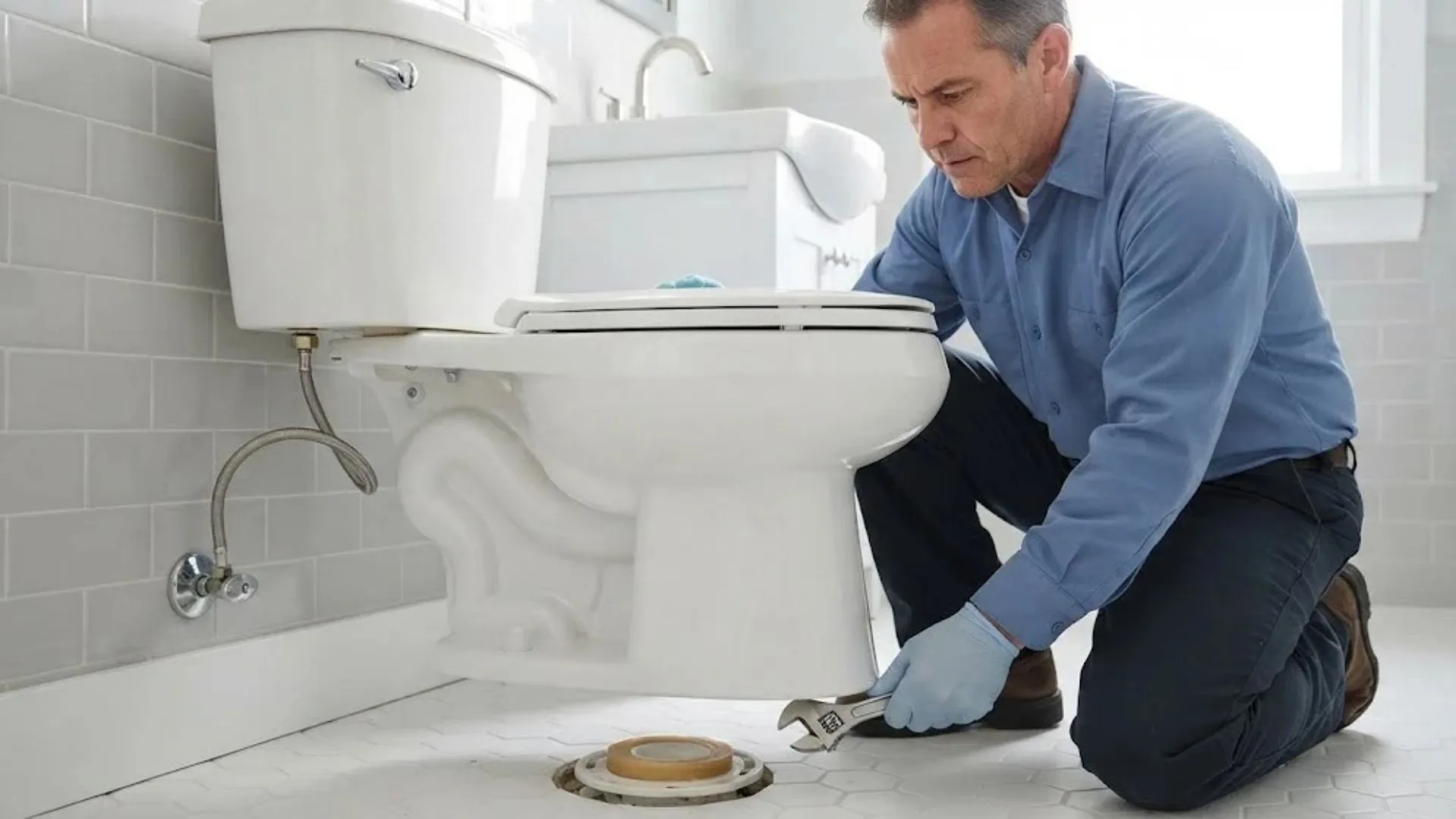
A toilet sits on a wax ring, a ring about the width of a doughnut that seals the bowl outlet to the floor flange. When the ring compresses unevenly or the bolts loosen, sewer gas and water slip past it. The first sign is often a damp patch near the base after a flush, or a smell that is stronger on one side of the room.
A bowl that rocks even slightly is a warning. The movement breaks the wax seal and can crack the flange, the plastic or cast iron collar screwed to the floor. A cracked flange is repaired with a repair ring or a replacement flange, then the toilet is set on a fresh wax ring and snugged evenly on its two closet bolts.
Do not caulk around a leaking base and hope. Caulk hides the water and lets it keep running under the tile, where subfloor rot starts. If a toilet is leaking and you cannot see where, ask us to also check whether the water is coming from a supply line, which is much cheaper to fix.
Running toilets, fill valves and what hard water does to them
Goleta Water District's 2025 water quality report gives a customer average hardness of 21 grains per gallon. In a toilet tank, that scale builds on the fill valve seat, the flapper and the float. Parts that would last years in soft water start to leak, hiss or stick sooner, so a rebuilt tank often fixes a toilet that has run on and off for months.
A running toilet can waste a surprising amount, as a flapper that seals poorly lets a thin stream trickle into the bowl all day. Put a few drops of food coloring in the tank, wait 15 minutes without flushing, and see whether color shows in the bowl. If it does, the flapper or its seat is leaking.
A fill valve that will not shut off sends water down the overflow tube. That is a cheap repair, but the water bill and the sound make it worth doing soon. A softener or filter reduces scale at the source if the whole house is wearing out fixtures.
What changes the price of a toilet repair
A new flapper and a new toilet are different jobs with different price tags. We give you a clear price before work starts, and these are the things that move it.
Sudden overflow that damages floors is sometimes covered, while a slow leak at the base that went on for months often is not. Take photos of the water, keep the damaged parts and call your insurer before replacing flooring.
Replacing a toilet instead of repairing it
Replace rather than repair if the bowl is cracked, the glaze is crazed, or the toilet needs a new fill valve, flapper and flange all at once. A toilet from the 1990s or earlier may use 3.5 gallons per flush, while many new models use 1.28 gallons or less and still clear the bowl.
Measure the rough-in before you shop. That is the distance from the finished wall to the center of the floor drain, and 12 inches is the most common. A 10 inch or 14 inch rough-in needs a matching bowl, and a standard toilet on the wrong rough-in will never sit right.
Installation takes the old toilet off, scrapes the old wax, checks the flange, sets the new bowl on a fresh ring and connects a new supply line. We can also swap the shutoff valve at the wall, which is worth doing if it is stiff or green with corrosion.
When the toilet is a sign of a bigger line problem
A toilet that backs up every few weeks, gurgles when a tub drains or sends water into a floor drain is not a toilet problem. The blockage sits farther down the line. In that case a plunger or a toilet auger only buys a few days, and a cable or sewer line cleaning does the real work.
The property owner maintains the lateral from the building to the street main, according to Goleta Sanitary District's FAQ. If the plumber's camera shows the blockage out past the cleanout, the district is the one to call. A plumber with a camera can show you which side of the property line it is on.
Rental buildings are more prone to this because many people share one lateral. Tenants in Isla Vista should tell the landlord first.
Related fixture problems we handle on the same visit
A toilet leak is sometimes the first sign of a wider water problem. If a stain spreads on the ceiling below, the supply may be leaking inside a wall, and leak detection finds it without opening every wall. If the stop valve behind the toilet will not close, see faucet and valve repair, which covers angle stops and supply lines.
Questions we hear most
Yes. The line is staffed 24/7, so an overflowing toilet at 3 a.m. or on a holiday gets the same dispatch as a weekday call. Tell the dispatcher whether water is still rising and whether you have a second bathroom.
Close the valve behind the toilet while you wait.
Not an emergency, but it wastes water and wears the tank. A flapper or fill valve repair is a quick job and can often be done on a same-day visit when we have an opening.
A rocking bowl means the wax seal or the flange is not holding. Tighten nothing hard, because over-tightening cracks the porcelain. A plumber resets the bowl on a new ring and repairs the flange if needed.
Yes. Replacing the wall shutoff at the same visit saves a second trip, and a stiff or leaking valve is the usual reason people avoid shutting water off in the first place.
If only one toilet is affected and the other drains work, it is the toilet or its branch. If a tub or floor drain also gurgles or rises, the main line is likely blocked and we clear it with a cable or jetter.
Tell your landlord or property manager first. Property managers can call the same 24/7 line, give the unit address and access details, and the plumber will confirm the work order before starting.