
What to do first when the disposal fails
A failed disposal is rarely dangerous if you leave it alone, but a few steps keep it that way.
Turn the power off
Flip the wall switch and unplug the unit or turn off its breaker. Never put a hand or a tool into the drain until the power is off, because the blades can start without warning.
Stop running water
A leaking or backed-up disposal is draining the sink. Do not run the faucet or the dishwasher, which shares the drain.
Catch the leak
Put a bowl under the disposal housing. If water is dripping from the top, the sink flange seal has failed. A drip from the side is often the dishwasher hose.
Do not pour chemicals
A caustic drain cleaner in a jammed disposal can splash back and damage the unit. Leave it for the plumber.
If the sink is full of dirty water and the other fixtures are slow, mention that on the call. Same-day and after-hours dispatch is available, and the plumber will check the kitchen line as well.
Humming, stuck and silent: what each one means
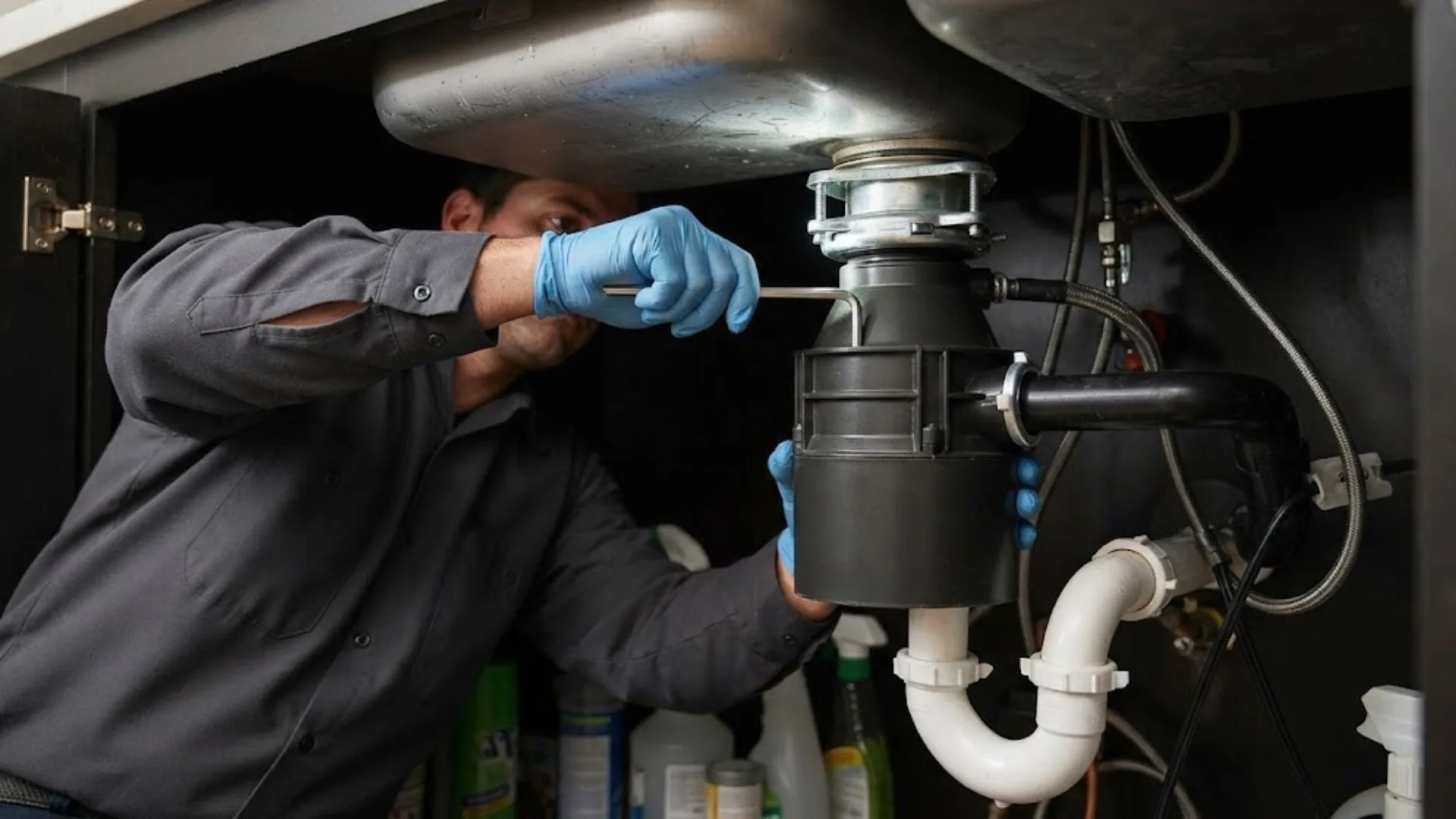
A hum with no spin means the blades are jammed. A food scrap, a bottle cap or a piece of bone has wedged the grinding plate. Most disposals have a hex socket in the center of the underside, about one quarter inch across. With the power off, an Allen key turned back and forth frees the plate.
A disposal that is completely silent has usually tripped its overload. Look for a small red reset button on the underside or the housing, press it once after the unit cools for a few minutes, and try again. If it trips again at once, the motor is failing or the jam is back.
These two steps are general, not instructions for your specific model, so read the label first. If neither works, or you smell something burning, stop and call.
The drain connection and any air gap or high loop for the dishwasher line follow the California Plumbing Code, which is built on the Uniform Plumbing Code (UPC), so the plumber checks that setup during a replacement.
Repair or replace the disposal
Most disposals last around a decade. This table helps decide whether a repair is worth it.
| Condition | Repair | Replace |
|---|---|---|
| Jam, no leak | Free the plate, test | Not needed |
| Leak at the sink flange | Reseal or replace the mounting ring | If the body is also corroded |
| Leak from the housing | Not repairable | Replace the unit |
| Motor hums, will not free | Try the hex key once | If the motor is burnt out |
| Unit near the end of its decade | Only for a cheap fix | Usually the better value |
Leaks from the flange, the housing and the dishwasher hose
Where the water appears tells you what failed. A leak at the top, around the sink flange, is a putty or gasket failure and is often repairable. A leak from the body, especially near the bottom, means the housing has rusted through, and that disposal is done. A leak at the side outlet is a loose drain elbow or a worn gasket.
The dishwasher hose attaches to a small inlet on the side of the disposal. If the hose clamp has slipped or the inlet is cracked, water drips each time the dishwasher drains. A new clamp and a fresh hose is a small job when caught early.
What changes the price of disposal work
A freed jam and a new disposal with new wiring are very different jobs. We give you a clear price before work starts, and these are the factors that move it.
A slow disposal leak that soaked the cabinet over months is often excluded, while a sudden failure may be covered. Photograph the damage and call your insurer before replacing a cabinet base.
Choosing and installing a replacement
Disposals come in one-third, one-half, three-quarter and one horsepower. A one-half horsepower unit suits light use, while a three-quarter or one horsepower model handles busier kitchens and tougher scraps. Larger units cost more but jam less, which matters in a house that cooks daily.
Installation follows a set order. The old unit comes down, the sink flange is cleaned and resealed with plumber's putty, and the mounting ring locks the new unit in place. The drain elbow connects to the trap, which is usually 1.5 inches. A disposal that does not fit the old mount may need a new ring.
Two details are easy to miss. The dishwasher inlet has a knockout plug inside that must be removed with a hammer and screwdriver, or the dishwasher will back up with the water that cannot get through. The electrical hookup needs a switched outlet or a hardwired box, and a hardwired connection is best left to a licensed plumber or electrician.
When the sink backs up, the problem is often the line
A sink that fills when the disposal runs, or a dishwasher that leaves water at the bottom, shares one drain. Grease and food particles narrow the kitchen line over time, and a new disposal will not clear that. A plumber can run a cable through the trap, and drain cleaning on the kitchen line often solves the problem the disposal never caused.
A disposal that leaks while a fixture above it drips may also need faucet repair on the same visit. Kitchen leaks that go on show up as a damp cabinet base, which leak detection can trace if the source is not obvious.
Hard water leaves scale in disposal seals and drain ports too, and Goleta's very hard supply shows up here as stiff, gritty parts. In Eastern Goleta Valley, where many homes are owner-occupied, replacing an old disposal along with its supply lines is a common call.
Questions we hear most
Yes. The line is staffed 24/7, so a disposal that is flooding the cabinet at night gets the same dispatch as a weekday call. Tell the dispatcher whether the unit is leaking and whether the sink is backed up.
Switch the power off at the wall in the meantime.
Never. Switch off the power at the wall and the breaker first, then use tongs or pliers to remove an object. Even a switched-off unit can start if the power is still live.
Often yes. With the power off, use a hex key in the bottom socket to turn the plate back and forth, then press the red reset button. If it stays stuck, call.
The dishwasher drains through the disposal. A blocked disposal, a blocked kitchen line or a missed knockout plug in a new unit causes it. We check all three.
Many last around a decade, though heavy use and hard water shorten that. A corroded body or a motor that keeps tripping the reset is the cue to replace.
Tell your landlord or property manager first. Property managers can call the same 24/7 line, give the unit address and access details, and the plumber will confirm the work order before starting.