
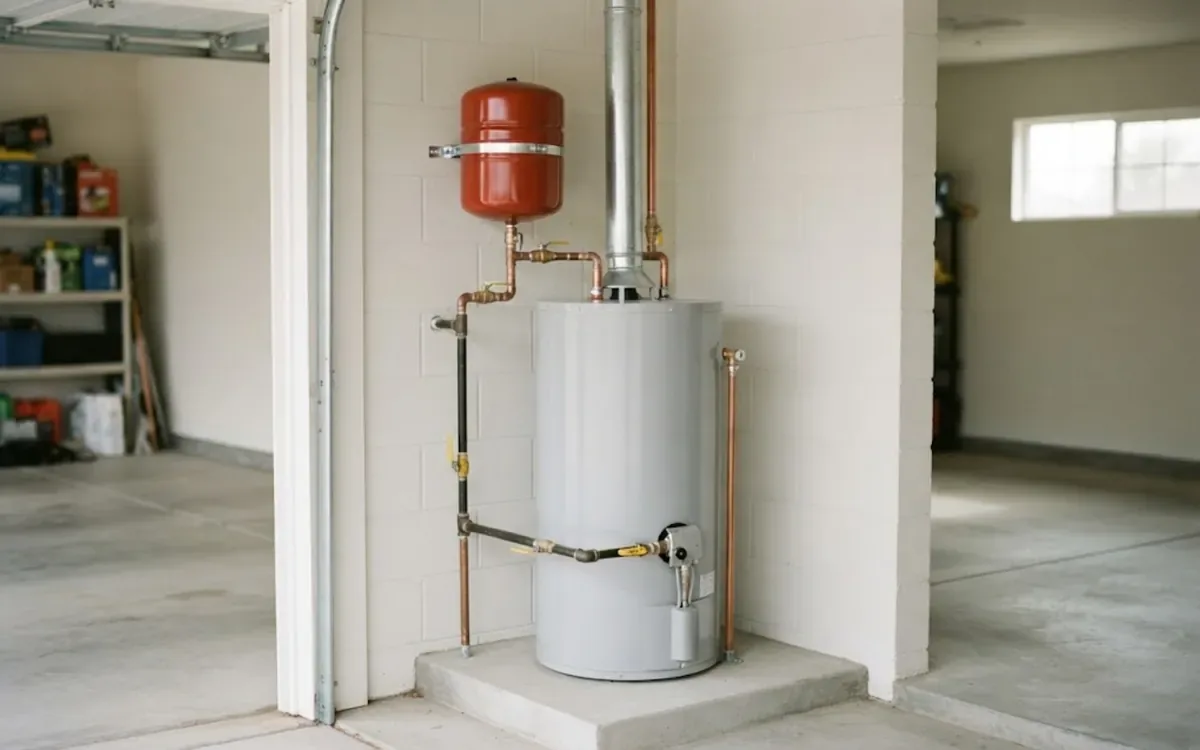
A tank that leaks from the shell cannot be fixed
A water heater tank is a steel vessel with a glass lining. When the lining cracks and the steel corrodes through, water escapes from the base or the seam and the failure is permanent. Patches, sealants and tightening do not hold against 40 to 60 pounds of line pressure.
Most tanks last roughly eight to twelve years, and very hard water can shorten that. The plumber confirms where the water comes from before calling it, because a leaking fitting or valve is a cheaper repair, covered on the water heater repair page.
Water on the floor: do this before the plumber arrives
A flooding heater can empty its tank in minutes and keep refilling from the supply line. These steps limit the damage.
Shut the cold supply valve
Turn the handle on the pipe above the heater a quarter turn if it is a ball valve, or clockwise if it is a gate valve. If the valve is stuck, close the main water shutoff at the house.
Cut power or gas
Flip the heater's breaker off. On a gas unit, turn the gas control knob to off. Do not stand in water to reach a panel.
Smell gas? Leave first
If you smell gas, leave the building and call your gas utility or 911 before calling a plumber.
Move belongings and photograph the damage
Lift boxes, cardboard and electronics off the floor. Take photos of the water line and the heater label for the insurance claim.
Do not drain the tank into the garage floor. The plumber connects a hose to the drain valve and runs it outside or to a drain.
Repair or replace: a decision table
Use this table to see which way the symptoms point. The plumber confirms before any work starts.
| What you find | Usually means | Verdict |
|---|---|---|
| Water seeping from the bottom or seam of the tank | Steel shell has rusted through | Replace |
| Water at a pipe fitting or the drain valve | Loose or corroded connection | Repair, see repair options |
| Tank is a decade old or more with a failing element or valve | Parts worth less than the remaining tank life | Often replace |
| Rusty water, rumbling and a rotten anode rod | Corrosion has started inside | Replace if the rod is gone and sediment is thick |
| Heater is young and only one part failed | Component fault | Repair |
Why Goleta tanks wear out sooner
The Goleta Water District 2025 water quality report gives a customer average of 21 grains per gallon, and the district's own page calls the supply very hard. Dissolved calcium and magnesium bake onto the tank floor and heating elements as scale.
A magnesium or aluminum anode rod sacrifices itself to protect the steel. In hard water the rod is consumed faster, and once it is gone the tank wall takes the corrosion. A heater that has never had its rod checked often fails before the label date. A softener or filter reduces scale on the next heater, so it is worth asking about when you replace.
Sizing the new heater by household
A tank is rated by gallons, but the number that matters is first-hour rating, the hot water it delivers in the first hour of heavy use. A one- or two-person home often does well with a 30 to 40 gallon tank. A family of four usually looks at 50 gallons, and a larger household with several bathrooms may need more or a high-recovery model.
Rentals near UC Santa Barbara and in Isla Vista can have many people sharing one heater, which pushes the size up. The plumber asks how many people and bathrooms are on the heater and sizes from there, instead of copying the old tank.
Swapping gas for a heat pump water heater
A heat pump water heater moves heat from the surrounding air into the tank, which uses far less electricity than a standard electric element. Switching from gas to a heat pump unit changes three things in the house.
Electrical
Most heat pump tanks need a dedicated 240-volt circuit, often 30 amps, so the panel must have room. A gas house may not have a 240-volt line near the heater, and the electrician or plumber must run one.
Space and air
The unit cools the air around it, and manufacturers specify how much open volume or ducting it needs. A tight closet that suited a gas tank can starve a heat pump, and a garage is often a better home.
Condensate
Pulling heat from air also pulls moisture, which collects as condensate and needs a drain or pump. The line has to run to a floor drain or a pump, and the plumber plans that run before you buy.
What changes the price of a replacement
The tank itself is only part of the bill. We give you a clear price before work starts, and these are the things that move it.
Homeowner policies often pay for water damage from a sudden tank failure but not for the heater itself. A slow leak that went on for months may be excluded. Photograph everything before it is cleaned up and ask your insurer what it needs.
What the emergency replacement visit covers
A good replacement is more than lifting one tank out and putting another in.
- Shut off and drain. Water, power or gas is isolated and the old tank is drained to a hose.
- Remove the old unit. Connectors are disconnected, the tank is carried out and the area is checked for rot or damage.
- Set and strap. The new tank sits on a level base, in a drain pan where required, and is strapped to the wall.
- Connect and test. Water, relief valve discharge, gas or electric and venting are connected, then leak-tested before power or gas comes on.
A planned swap follows the same steps with more choice about type and placement, covered on the installation page.
Permits and strapping in Goleta and nearby
The City of Santa Barbara issues a same-location water heater replacement as an OnDemand permit with no plan review for one- and two-family homes, and a contractor licence is required to obtain it. For Goleta, permit rules vary, so ask City of Goleta Building and Safety. In unincorporated areas, ask County Building and Safety.
California Health and Safety Code 19211 requires replacement water heaters up to 120 gallons that have an off-the-shelf kit to be braced, anchored or strapped. Straps are part of every swap we plan. For a flood beyond the heater, see burst pipe repair. Residents of Isla Vista and Santa Barbara ask about permit offices often.
Questions we hear most
Yes. The line is staffed 24/7. If your tank fails at night, call, close the supply valve and the dispatcher books the replacement visit. Same-day scheduling depends on parts and availability.
Usually yes. Water from the base or seam means the steel has failed and replacement is the only fix. The plumber checks fittings and valves first to be sure that is not the source.
Shut off the cold supply, then the power or gas. Move belongings and photograph the damage. Call so the plumber can stop the source and begin the swap, and ask your insurer about drying.
Tank units often last eight to twelve years. Very hard water, like Goleta's 21 grains per gallon average, can shorten that, and an anode rod that has never been checked is a common reason.
Often yes. A heat pump unit needs a 240-volt circuit, enough surrounding air and a condensate drain. The plumber checks all three before you buy one.
Size by household and first-hour rating, not just by gallons. Two people often manage with 40 gallons, while four or more usually want 50 or higher.
Permit rules vary, so ask City of Goleta Building and Safety, or County Building and Safety if you are in an unincorporated area. A licensed plumber can tell you who pulls the permit under the contract.
Yes. Property managers call the 24/7 line with the unit address and access details. We recommend a drain pan and straps for any heater in a garage or closet.