
When a snaked line clogs again, it is an emergency
A snake that works for a week and then fails is a sign. The tool opened a hole in the blockage, but the buildup that caused it stayed on the pipe wall.
It cleared, then clogged within weeks
The cable punched through, and grease, scale or roots grew back into the gap. Jetting washes the wall itself, which is what a repeat clog needs.
The snake got stuck or came back with roots
A cable that hung up, or came out wrapped in fibers, found roots or a damaged joint. Say so on the call because a camera check comes before any high-pressure work.
Backups keep arriving at the lowest drain
A floor drain or ground-level tub that rises when the washer drains points to a narrowed main line. Stop using water and call right away.
A kitchen line is slow in a restaurant or rental
Heavy grease use fills a line faster than a house line fills. If the kitchen cannot run, this is a same-day call.
If sewage is on the floor, keep people and pets out of that room and do not run the disposal, dishwasher or washer. The plumber confirms the pipe is sound before any pressure goes in.
How a hydro jetter cleans a pipe
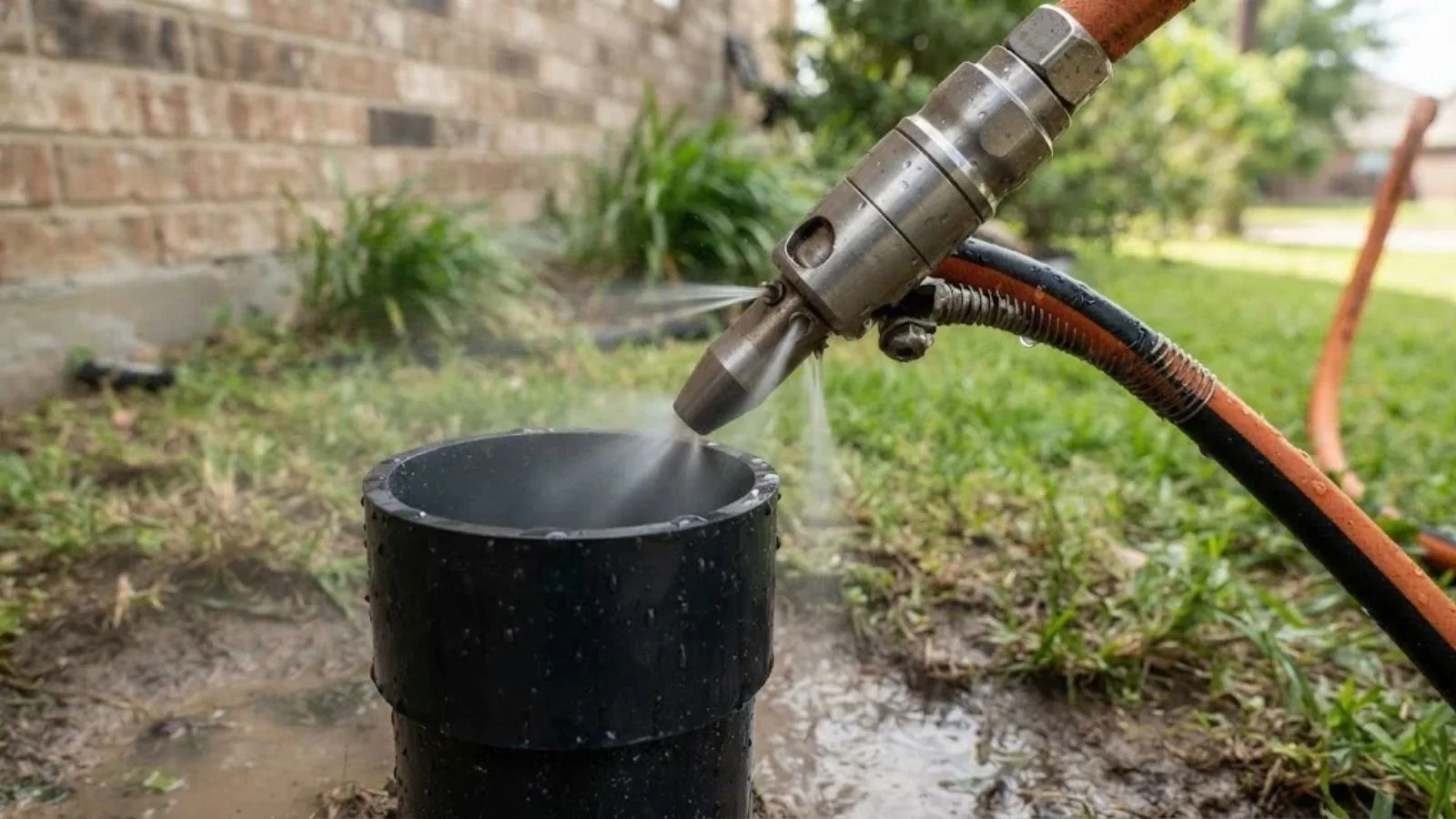
A jetter is a pump that pushes water through a flexible hose, usually at pressures measured in the thousands of pounds per square inch. The hose goes in through a cleanout, and the nozzle on its end turns that pressure into small streams of water. A snake pushes a cutter through the clog. A jetter rinses the pipe wall around it.
Most nozzles have rear-facing jets. Those jets pull the hose forward through the pipe on their own, and they push loosened debris back toward the cleanout where it can be rinsed out. The operator feeds the hose in, then works it back out slowly so every foot of pipe gets washed.
That is why jetting leaves a pipe closer to its original width. A typical 4-inch sewer lateral that has grease and scale on the wall can be working as a 2-inch pipe long before it stops completely. Jetting aims to open the whole bore, not just a path through it.
Cleanouts that make jetting possible are part of what the California Plumbing Code, built on the Uniform Plumbing Code (UPC), expects on a building sewer, which is why a missing cleanout is worth adding.
Nozzle types and what each one is for
The nozzle matters as much as the pressure. A plumber picks it from what a camera or a snake has already shown.
| Nozzle | What it does | Used on |
|---|---|---|
| Penetrating nozzle | Narrow forward jet that opens a tight blockage | Fully stopped lines and hard plugs |
| Rear-facing flushing nozzle | Pulls the hose forward and rinses the wall as it returns | Grease and soft debris in 3 to 6 inch lines |
| Spinning scale nozzle | Rotating jets scour the wall | Mineral scale and baked-on grease |
| Root-cutting nozzle | Spins a cutter edge on the jet | Fine roots inside joints |
Roots, grease and scale: what jetting does with each
Three kinds of buildup cause most repeat clogs. Jetting handles them differently.
Roots
Fine roots entering at joints can be cut back and flushed. Jetting does not seal the joint, so roots often return until the joint itself is fixed. See sewer line repair for that step.
Grease
Cooking fat cools into a hard layer on the pipe wall. Hot, high-pressure water breaks it up and carries it out, which a cable cannot do.
Scale
Goleta Water District reports hard water at an average of 21 grains per gallon. In drains that hardness can leave mineral scale that a spinning nozzle can scour.
Soap curd and paper
Soap, hair and wet-wipe fibers pack into a felt-like layer. A flushing pass clears it and leaves smoother walls that stay clear longer.
The Goleta West Sanitary District's fall 2018 newsletter says its camera inspections found sewer defects mainly from root intrusion. If your cable keeps coming back with fibers, roots are a likely cause.
When jetting is the wrong tool
High-pressure water is not safe in every pipe. A cracked, collapsed or separated pipe can be damaged further, and water forced out of a break can wash away the soil around it. Old clay and fiber pipe, and thin-walled cast iron, can be too fragile to jet at full pressure.
That is why a camera comes first when the line is unknown, the snake hung up, or the clogs keep coming back. The picture on the screen decides whether jetting, a lower-pressure cleaning or a repair is the right next step. A sewer camera inspection often costs less than finding out the hard way.
What changes the price of a jetting visit
A jetting call is priced from the job, not from a flat rate. We give you a clear price before work starts, and these factors move it.
Homeowner policies often treat jetting as maintenance and may not pay for it. Some include a sewer backup endorsement that covers damage from a backup, so photograph the area and read your policy before the visit.
Restaurants, rentals and shared lines
A commercial kitchen sends far more grease down its drains than a house does. Scheduled jetting, with a grease trap that is emptied on time, keeps a line from filling between emergencies. For a bigger building or kitchen, see commercial plumbing for the other systems a plumber looks at in the same visit.
Rental buildings and duplexes share one lateral, so a clog in one unit shows up in the lowest one. In Isla Vista, where Goleta West Sanitary District collects sewage for roughly 6,100 connections, a property manager can call the 24/7 line with the unit address and book a jetting pass before tenants are affected.
Honest limits of jetting
Jetting cleans, it does not repair. It cannot remove a root that has grown through a joint for years, straighten a sagging section where water pools, or patch a crack. If the camera shows any of those, the plumber will say so and discuss repair rather than sell another cleaning.
Jetting also cannot reach past a clog the hose cannot enter. If a toilet or a trap blocks access, the plumber may pull it or use a cleanout. Start with drain cleaning for ordinary clogs and move to jetting when the same line keeps failing.
Questions we hear most
Yes. The line is staffed 24/7, so a restaurant drain that fails on a Saturday night or a main line that stops on a holiday gets booked the same way as a weekday call. Tell the dispatcher what the line serves and what has already been tried.
Often, yes. A repeat clog usually means the pipe wall is coated with grease, scale or roots that a snake only punctured. A short camera look first confirms the pipe is sound enough for jetting.
A stuck cable can mean a root mass, a broken joint or a pipe that has shifted. Do not keep pulling on it. Tell the dispatcher, because a camera is needed before any high-pressure water goes in.
Jetting can cut fine roots and wash them out, but roots follow moisture through joints and cracks and will return. A repair or a section replacement is what ends it, and your district may have rules on the method.
It can on a pipe that is cracked, collapsed or very old. A plumber checks the pipe with a camera when the condition is unknown and chooses a safe pressure and nozzle for the pipe material.
It depends on how much grease the kitchen produces and how often the trap is emptied. A heavy fryer menu fills a line faster than a sandwich shop. Ask the dispatcher to look at your records and suggest a schedule after the first visit.
That depends on the lease and on the cause. A clog from tenant misuse and one from roots in an old lateral are treated differently. Tell the plumber who is calling so the work order and invoice go to the right person.