
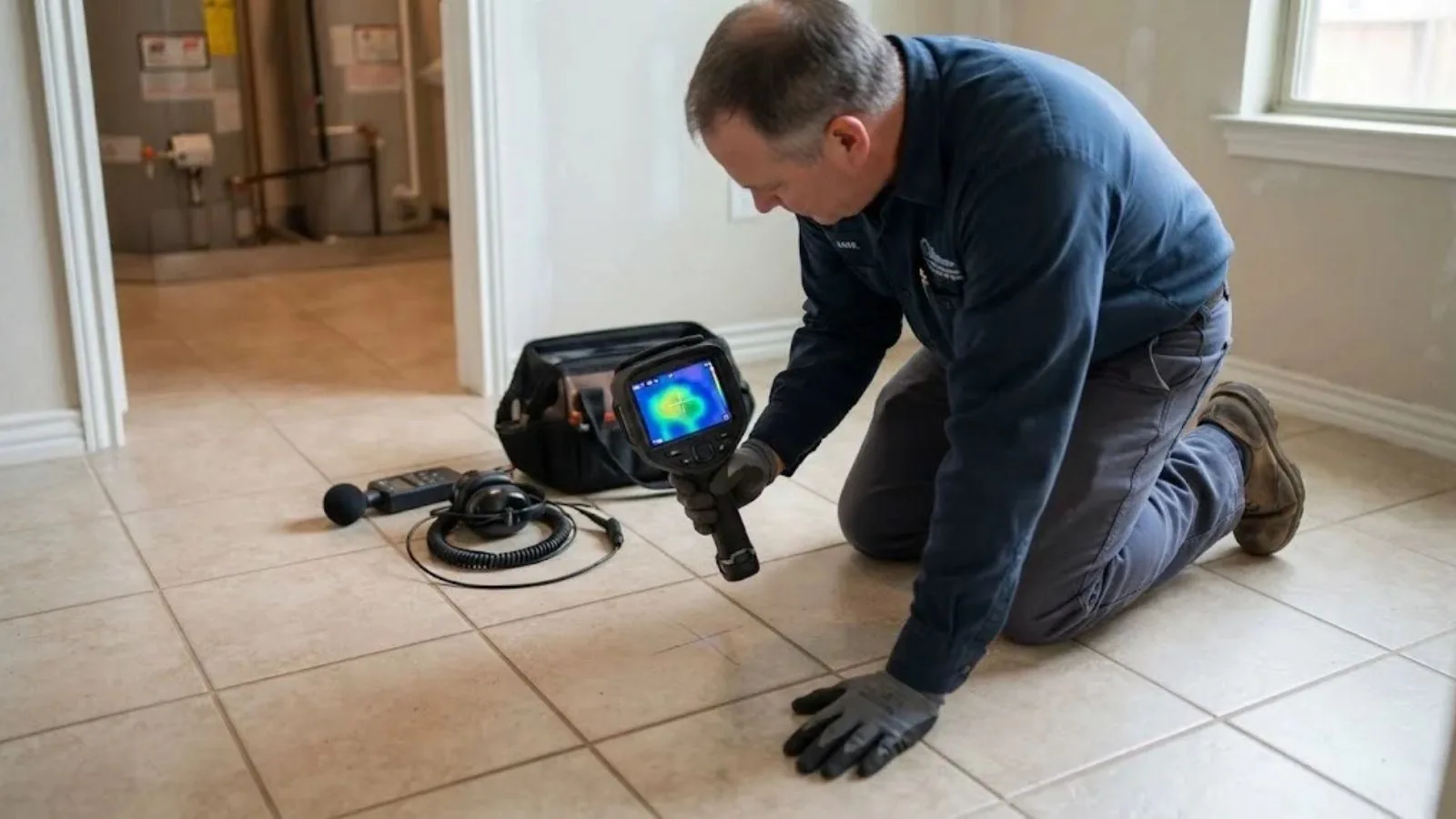
Water you cannot see: how the cause gets found
Leak detection is the work of locating a leak in a pressurized water line without tearing out walls, floors or yards. It starts with the symptom, then narrows the search with tests that rule whole sections of pipe in or out.
Most hidden leaks announce themselves in one of a few ways. The meter runs with everything off, the water bill climbs without a change in habits, a patch of floor stays warm, drywall turns soft, pressure drops at the faucets, or you hear water running behind a wall at night.
Once the leak is found, the repair is made to the California Plumbing Code, which is built on the Uniform Plumbing Code (UPC), and the plumber should explain how the opened wall or floor will be restored.
Symptom to method: what finds which leak
This table matches what you notice to the test that usually finds the source first.
| What you notice | Likely location | First method |
|---|---|---|
| Meter turns with everything off | Service line, house supply or a running toilet | Meter check, then pressure test by section |
| Warm spot on a floor | Hot line under a slab or in a floor cavity | Thermal imaging, then acoustic listening |
| Damp drywall or a ceiling stain | Supply or drain line inside a wall or above the ceiling | Moisture meter, then camera through a small opening |
| Sound of running water at night | Pressurized line in a wall or crawlspace | Acoustic listening with a contact microphone |
| Wet or sunken yard strip | Buried service line or irrigation line | Line tracing, then ground listening |
| Low pressure at every faucet | Main line, shutoff or pressure regulator | Gauge at a hose bib, then isolate the main |
Meter still running or the bill jumped: a ten-minute check
A meter that moves when nothing is using water is the clearest sign of a leak somewhere between the street and your fixtures. You can confirm it yourself before anyone arrives. The Goleta Water District meter sits in a box near the curb or property line, usually under a lid you lift with a screwdriver.
- Stop every use of water. Close taps, pause the washer and dishwasher, and shut off irrigation and any ice maker. Ask everyone in the house to hold off flushing.
- Find the leak indicator. Most residential meters carry a small low-flow indicator, often a triangle, star or tiny wheel, that spins when even a trickle passes through. If it turns with everything off, water is moving.
- Read the dial and wait. Note the register digits and the units, which may be gallons or cubic feet. Wait 30 to 60 minutes with no water use, then read it again. Any change confirms a leak.
- Shut the main valve and look again. Close the shutoff at the house and check the indicator. If it stops, the leak is inside the house. If it keeps turning, the leak is on the line between the meter and the house.
- Rule out the toilets. Drop a few drops of food coloring in each tank and wait 15 minutes without flushing. Color in the bowl means a flapper is leaking.
What a usage jump on the bill really tells you
A bill that jumps with no change in household habits is data, not a diagnosis. A guest, new irrigation or a filled pool can explain a rise, so compare with the same month last year. If usage stays up and the meter indicator moves at night, a leak is the likely cause.
Goleta Water District's rule, which stayed in effect after the 2019 shortage ended, is that leaks must be fixed inside 24 hours. That makes a confirmed leak a same-day matter. The district also has a Leak Adjustment Request form, so ask GWD how it applies to your account and what paperwork it wants. Keep the plumber's written findings and repair record.
When a hidden leak is an emergency
A slow drip can wait for tomorrow. These cases cannot, because water is spreading fast or touching something dangerous.
Water is coming through a ceiling
A bulging or dripping ceiling holds water that can drop at once. Shut off the main valve, keep people out from underneath, and call right away.
The meter spins fast with everything off
A fast indicator means a large opening, often a failed joint or a broken line. Close the main valve and call the 24/7 line.
Wet floor near outlets or the panel
Water close to electrical equipment is a shock risk. Turn off power to that area only if you can reach the breaker without stepping in water.
A warm patch or hissing from the floor
Hot water escaping beneath flooring can lift it and soak the subfloor. Shut off the water heater supply and the main, then call.
If you smell gas along with any of this, leave the building first and call your gas utility or 911 before calling a plumber.
Detection methods and what each one cannot see
No single tool finds every leak. Each one answers a different question and has blind spots, which is why the plumber chooses by symptom and often stacks two methods.
Acoustic listening
Contact microphones and ground microphones pick up the hiss or hum of pressurized water escaping a pipe. They work well on metal lines and on quiet nights. Plastic pipe carries sound poorly, and traffic or pumps can drown the signal out.
Thermal imaging
An infrared camera shows temperature differences on a surface. It reveals a hot water leak under flooring or a cold stain inside a wall. It cannot see through thick materials, and a cold line leaking in a similar temperature to its surroundings may show little contrast.
Pressure testing
The plumber isolates a section, applies pressure and watches a gauge for a drop. It proves whether a line leaks and in which section. It does not say where along the pipe the opening is, so it pairs with listening or tracing.
Tracer gas
A nonflammable mix of hydrogen and nitrogen is pushed into an emptied line, and a sensor at the surface picks up gas rising through the soil, slab or wall. It suits quiet leaks, but the line must be drained first.
Line tracing
An electronic locator follows the path of a buried pipe so any digging happens in the right place. Metal pipe can be traced directly. Plastic pipe needs a tracer wire or a transmitter.
Moisture meters and cameras
A moisture meter reads how wet drywall, wood or concrete is, and it maps the damp area. It tells you where water is, not where it started. A small inspection camera or a drain camera can then confirm the source through a coin-sized opening.
Ceiling, wall and attic leaks
A stain on a ceiling is where the water finally showed up, not where it began. Water travels along framing before it drips, so the origin can sit feet away. A moisture meter maps the wet area, then a thermal camera or a camera through a small cut shows which pipe or fixture sits at the center.
Common sources include a failed supply connector above, a drain joint in a wall, a shower valve and a pipe in the attic. Roof and window leaks look the same from below, so the plumber rules out rainwater before cutting into plumbing.
Under the house and in the crawlspace
Homes with a raised floor have a crawlspace where supply lines, drains and sometimes the water heater run. Leaks there give away their presence through a musty smell, a spongy floor over one spot, a sudden rise in the bill or a hiss you can hear from the room above.
Corrosion pinholes in older copper and failed galvanized fittings are frequent finds under a house. If one fitting has failed, the neighbors around it are often close behind, and that is when replacing the run becomes a sensible conversation. If the leak is under a concrete floor instead, see slab leak repair.
Buried service line leaks between the meter and the house
The service line carries water from the meter to the house, often through 60 or more feet of soil, and a leak on it can run for months with no wet spot at the surface. The meter indicator keeps moving after you shut the main valve at the house. That is the sign the leak is on this stretch.
A California C-36 Plumbing Contractor license covers water and gas lines from the owner's side of the meter to the building, which is the stretch you are responsible for. The meter itself and everything on the street side belong to the utility. If you are unsure where your responsibility starts, ask GWD before anyone digs.
To find the break, the plumber first traces the pipe path, then listens along it with a ground microphone and uses tracer gas where the noise is faint. Digging is limited to the confirmed spot.
Goleta conditions that change the search
Local water and weather do not cause leaks by themselves, but they shape where the plumber looks and what you can do afterward.
21 grains per gallon
Goleta Water District's 2025 report gives a customer average of 21 grains per gallon, and it calls the water very hard. Scale narrows pipes and clogs aerators, so low pressure alone does not prove a leak, and a pressure test tells the two apart.
Storm-season ground
The January 9, 2023 storm closed the airport airfield for about 27 hours. Soaked ground shifts, so a bill that jumps after a wet winter deserves a meter check.
Airport and slough floodplain
Santa Barbara Airport sits in the Goleta Slough floodplain, next to Hollister Avenue. Low ground can hide a buried leak under standing water, which is where tracer gas helps.
Irrigation, pool, yard and meter-box leaks
Outdoor water use can hide leaks that the indoor checks miss, so the search often extends past the walls.
Sprinklers and drip lines
A stuck valve, cracked riser or chewed drip line can run for hours. A wet strip or a low-pressure zone points to the break. Switch off the controller and watch the meter to see whether the system is the source.
Pools and spas
Pools lose water to evaporation, so a bucket test comparing the pool level with a bucket of water set on the step over a few days separates a leak from evaporation. If the pool drops faster, the plumber pressure tests the underground return and suction lines.
Yards and meter boxes
Water pooling at the meter box can be a leaking meter connection, a failed shutoff or a break just past it. A wet meter box is worth a call to GWD, since the meter is the utility's. A leak on your side of the box is a plumber's job.
What changes the price of leak detection
Finding a leak is priced by how hard the search is, not by a flat list. We give you a clear price before work starts, and these are the factors that move it.
Many homeowner policies cover sudden water damage but may exclude the cost of finding the leak or repairing the pipe itself. Some include a separate tear-out and access endorsement. Photograph the damage, keep the meter readings, and read your policy before the visit.
After the leak is found: repair paths and commercial buildings
Once the spot is confirmed, the plumber lays out the options. A pinhole in a healthy pipe can be spot-repaired, while a split or corroded run points toward burst pipe repair or full replacement. A leak that signals a failing system is the moment to price a whole-house repiping job.
Leaks in a store, restaurant or office follow the same logic, but access rules, after-hours schedules and shared lines change the plan, and that work is covered under commercial plumbing. The same 24/7 line serves both. Homes in Santa Barbara and nearby towns are covered too.
If water is also draining slowly, a leak and a drain problem may be one story, so drain cleaning or a sewer camera inspection answers the second question.
Questions we hear most
Yes. The line is staffed 24/7, so a ceiling leak at 2 a.m. or a meter spinning on a holiday gets the same dispatch as a weekday call. Tell the dispatcher what you see, whether the main valve is shut and whether the water is touching electrical equipment.
Same-day appointments are offered when available, and after-hours calls are priced and explained before you book.
Compare usage with the same month last year and check for new irrigation, guests or a pool fill. Then do the meter check with everything off. A moving indicator means a leak, and Goleta Water District expects leaks to be fixed inside 24 hours. Ask GWD about its Leak Adjustment Request form and keep the repair record.
The line from the owner's side of the meter to the building is generally the property owner's to maintain. For the exact boundary on your address, ask Goleta Water District. A plumber can locate and repair the leak and tell you which side it sits on.
Not by itself, since a sunny window or radiant heating can warm a spot too. If it stays warm with the water heater off, or the meter moves, a hot line is likely leaking. A pressure test confirms it.
Yes. Property managers can call the 24/7 line with the unit address, and the plumber confirms the work order before starting. Tenants who spot the leak should tell the manager first and shut the main valve if water is spreading.