
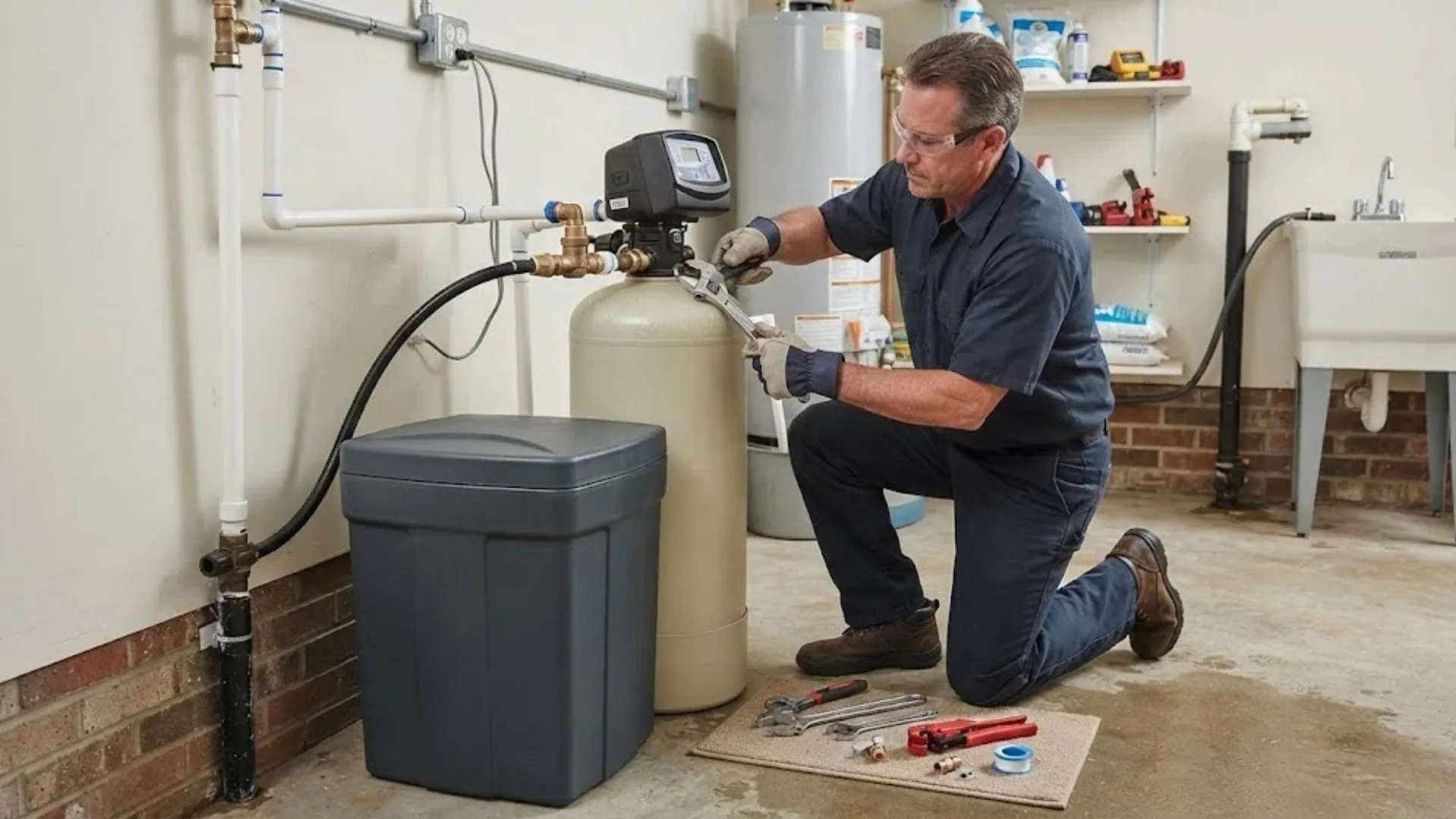
What a softener does and what it leaves alone
A water softener swaps the calcium and magnesium that cause hardness for sodium or potassium, using a bed of resin beads. When the beads fill, the control valve flushes them with a salt brine and the cycle starts again. Softened water leaves less scale in pipes, water heaters and fixtures.
A softener does not remove chlorine, bacteria, or most chemicals. Those are handled by filters, such as carbon, and by reverse osmosis. That is why a softener and a filter are often installed together and not as substitutes.
Softener plumbing, bypass valves and drain connections follow the California Plumbing Code, built on the Uniform Plumbing Code (UPC), including how the discharge line is air-gapped.
Hardness in the Goleta area by water source
These figures come from each water provider's own reports. They are measured as calcium carbonate in milligrams per liter, and dividing by 17.1 gives grains per gallon.
Goleta Water District reports 21 grains per gallon as the customer average, and its disinfectant is chlorine, not chloramine. Your street may receive a blend, so check your own water quality report.
Softener, filter, reverse osmosis or scale inhibitor
These four do different jobs. Choose by the problem you want to solve.
| Option | What it does | What it does not do |
|---|---|---|
| Salt-based softener | Removes hardness minerals, protects pipes and heaters, improves soap lather | Does not remove chlorine or contaminants, adds sodium, uses salt and water to regenerate |
| Whole-home carbon filter | Reduces chlorine taste and odor for every tap | Does not remove hardness |
| Reverse osmosis at one tap | Removes dissolved solids at the drinking tap | Treats only that tap and wastes some water |
| Scale inhibitor (template-assisted crystallization) | Changes scale so it sticks less, no salt or drain | Does not actually remove hardness minerals, and results vary |
Sizing a softener from hardness and household
Size is based on how much hardness the unit has to remove each day. Multiply your hardness in grains per gallon by the gallons your household uses daily. For example, 21 grains per gallon and 300 gallons a day is about 6,300 grains of hardness a day.
A 32,000-grain unit would then regenerate roughly every five days, ignoring the reserve a good system keeps. Common sizes run from 24,000 to 48,000 grains. Oversizing wastes salt and water, and undersizing regenerates too often.
The plumber measures your actual hardness with a test kit, counts people and bathrooms, and checks flow rate.
Signs a softener or conditioner needs repair
A softener is a small machine with moving parts, and most failures are simple. These signs usually mean service is due.
Hard water is back
Scale, spotty glasses and poor lather return when the resin is spent, the valve fails to regenerate or the unit is in bypass.
The brine tank is full of water
A tank that stays full of water points to a blocked brine line, a stuck valve or a drain restriction.
A salt bridge or mush
Salt can form a crust over a gap, or cake at the bottom. The unit then has no brine to regenerate with.
It runs to drain constantly
A water sound at the drain with no cycle points to a worn valve or seal letting water bypass the bed.
Pressure dropped after the unit
Broken-down resin beads can clog the valve and screens.
The display is blank or stuck
A failed timer, a dead power supply or a stuck motor stops regeneration.
Control valves, brine tanks, bypass valves and resin
Most repairs are in one of four parts, and the plumber diagnoses which.
Control valve
The valve runs the regeneration cycle. Worn seals, a failed motor or a bad circuit board can stop it. A replacement valve head is often a better value than rebuilding a very old one.
Brine tank
The tank holds salt and brine. The most common faults are a salt bridge, a clogged brine well and a broken float. Cleaning the tank and replacing the screen often restores it.
Bypass valves
Bypass valves let you route around the softener for repairs. If one leaks or sticks, hard water can reach the house when it should not, or soft water may not flow when it should. They are inexpensive to replace.
Resin and whole-home filters
Resin lasts many years, but chlorine and iron slowly degrade it. Carbon filter media wears out and needs changing on a schedule.
Backflow, drains and the districts to ask
Goleta Water District says a backflow device is often required because irrigation, pools, water softeners or leaks can create back pressure, and devices on approved projects must be tested annually by a state-certified tester. Ask GWD whether yours does.
Rules on where a softener's brine can drain are set by the water utility and the sanitary district, and no rule could be confirmed for this page. Ask your water utility and your sanitary district, which may be Goleta Sanitary District or Goleta West Sanitary District, before you install.
The California C-36 plumbing contractor class covers replacing and maintaining water conditioning equipment, so a licensed plumber can do the work. Permit rules vary, so ask City of Goleta Building and Safety.
What changes the price of a softener or filter job
Treatment equipment ranges from a cartridge filter to a full softener with a bypass and a drain. We give you a clear price before work starts, and these factors move it.
Homeowner policies do not cover treatment equipment that has worn out, but a leak from a failed softener line may fall under sudden water damage. Keep the receipt and the plumber's notes.
Related plumbing questions
Hard water also shortens water heater life, and sediment builds in the tank. Water heater repair covers flushing and element checks. Low pressure can also come from scale in old supply lines, which is where repiping enters the picture.
We serve Goleta and nearby towns, including Montecito, where the Montecito Water District publishes its own hardness figures. The 24/7 line also books planned work like this.
Questions we hear most
Goleta Water District's 2025 report gives a customer average of 21 grains per gallon. Cachuma surface water measures 360 mg/L and groundwater 470 mg/L as calcium carbonate. Your street may receive a blend, so check your own report.
A softener treats hardness. A carbon filter treats chlorine taste and odor. Many homes with very hard water add a softener for the pipes and heater, and a filter for the drinking water.
No rule was found for this page, so ask your water utility and your sanitary district before installing. Do not assume it is allowed or forbidden.
Often, yes. Tell the dispatcher the brand and what it is doing, and the plumber brings likely parts.
Yes. Property managers can call the line with the unit addresses, and the plumber confirms the work orders before starting.