
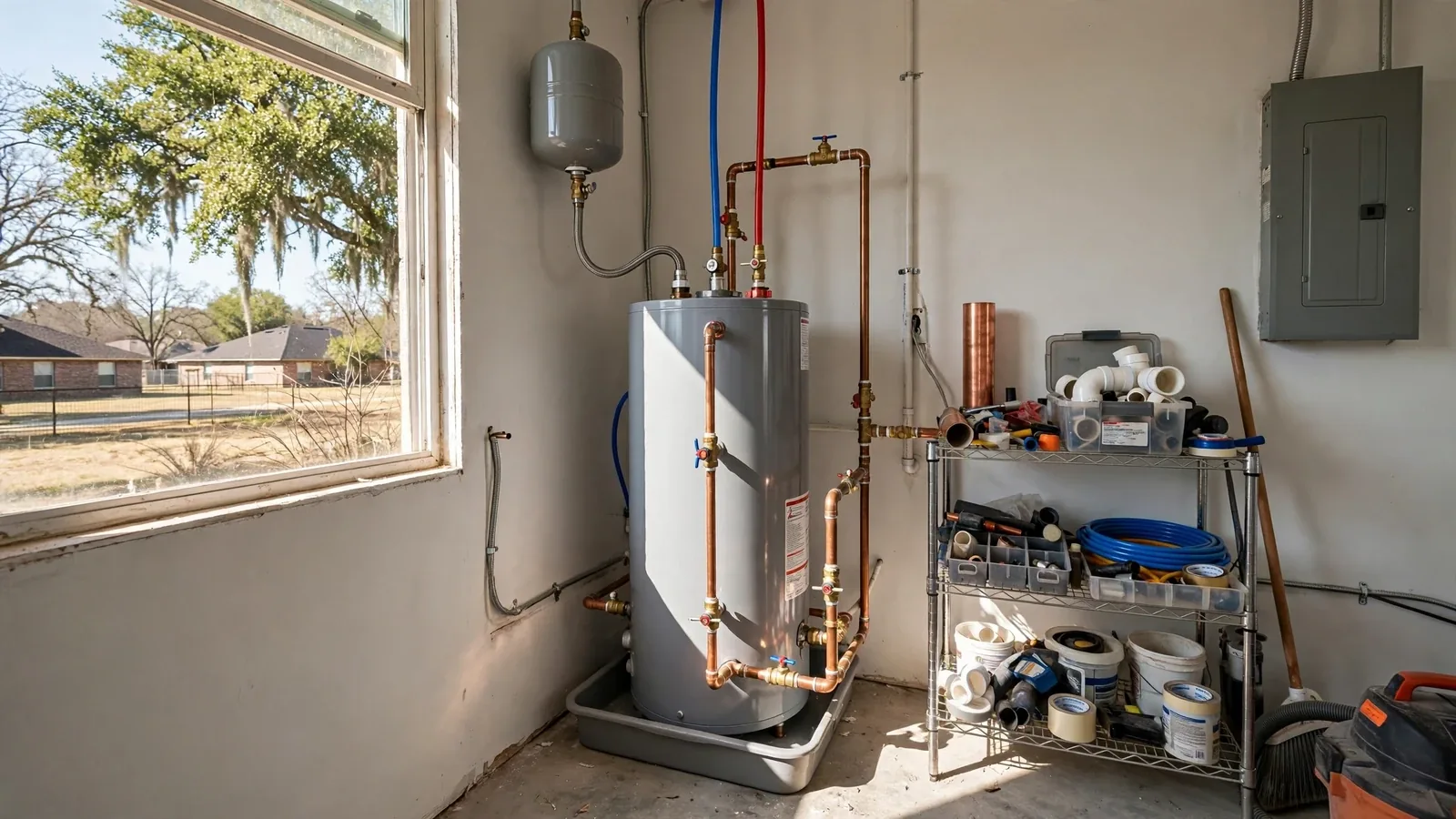
The short version: pros and cons
Most of the decision comes down to the room the heater lives in and the circuit feeding it.
Pros
- Uses much less electricity than a standard electric tank
- Has a built-in backup element for high demand
- Dehumidifies and cools the air around it
- Incentive programs may apply, so ask before you buy
Cons
- Costs more up front than a standard tank
- Needs open air space and a condensate drain
- Makes fan and compressor noise
- Heats the tank more slowly in heat pump mode
The next sections look at each trade-off in turn, so you can judge what applies to your house.
How a hybrid water heater works
A heat pump water heater sits on top of an ordinary insulated tank. A fan draws room air across a coil, a compressor moves the captured heat into the water, and cooled air leaves the unit. Most models also carry electric elements for fast recovery or cold rooms.
The unit can run in several modes, usually efficiency, hybrid and electric only. Efficiency mode relies mostly on the heat pump, and electric mode uses the elements. Choosing the mode is how you balance savings against recovery speed.
Space, noise, condensate and wiring
These four practical points decide whether a heat pump unit fits your house.
Space and air
Manufacturers commonly call for several hundred to about 1,000 cubic feet of air around the unit, plus clearance for the filter and service. A small closet with no vents often does not work.
Noise
The compressor and fan sound like a dehumidifier or window air conditioner. A garage or utility room handles that better than a closet beside a bedroom.
Condensate
Pulling heat from air pulls moisture too. The unit needs a drain line or small pump to carry that water to a floor drain or outside.
Electrical
Most models need a dedicated 240 volt circuit, and some run on 120 volts. An older panel may need work before the unit can be added.
These needs make a heat pump unit more of a project than a like-for-like tank swap. A plumber and an electrician may both be involved.
Weighing a heat pump unit?
Call the 24/7 line and tell the dispatcher where the heater sits now. A plumber can talk through space, drain and circuit needs and give a clear price before work starts.
Standard electric tank versus heat pump unit
This table compares the points homeowners ask about most.
| Point | Standard electric tank | Hybrid heat pump |
|---|---|---|
| Electricity use | Higher, since elements make all the heat | Much lower in heat pump mode |
| Up-front cost | Lower | Higher, with extra parts and wiring |
| Space needed | Compact | Taller, with open air around it |
| Noise | Nearly silent | Fan and compressor hum |
| Condensate drain | Not needed | Needed for moisture |
| Recovery speed | Quick with both elements | Slower unless it switches to elements |
How to think about savings
Heat pump units save money because they move heat instead of making it. How much you save depends on your household's hot water use, your electric rate and where the heater sits. A large family using lots of hot water sees a bigger benefit than one person living alone. Ask for the efficiency rating on the label, and ask what incentives apply before you decide.
Goleta water, permit and strapping notes
Goleta Water District's 2025 report gives a customer average hardness of 21 grains per gallon. Scale collects in any tank, so plan on flushing a heat pump unit's tank on the schedule the maker lists and consider a softener if your water is hard.
California Health and Safety Code section 19211 requires new and replacement water heaters to be braced, anchored or strapped against earthquake motion. Heat pump units are taller and heavier than many standard tanks, so the strapping matters.
A new circuit and a condensate drain may change what a permit covers. Permit rules vary, so ask City of Goleta Building and Safety, or County Building and Safety if your address is unincorporated.
Is your home a good match? A quick check
Walk through these questions before you ask for a quote.
- Where would the unit go? A garage, utility room or large closet with open air works. A tight closet with no airflow does not.
- Is there a drain nearby? A floor drain or a spot where a pump can send condensate outside makes the install simpler.
- Can the panel carry a 240 volt circuit? An electrician checks the panel and the wire run.
- How much hot water does your household use? More use means more savings from the heat pump.
- What is the noise tolerance next to the unit? Think about bedrooms and home offices on the other side of the wall.
Choosing between a heat pump unit and a standard replacement
If your current tank fails and you need hot water that day, a standard replacement can be the quicker path. A heat pump unit may need parts, wiring and a drain that take planning. Our water heater replacement visits start with what the house already has and what it can take.
When you are choosing a new unit and have time to plan, talk through the heat pump option as part of water heater installation. The plumber checks space, drain and circuit and gives a clear price before work starts.
A heat pump unit in a cold garage can lose some of its efficiency. Ask the plumber how the model you are considering handles low room temperatures and whether the elements will take over often.
Neighboring towns and the same questions
In the City of Santa Barbara, a water heater replacement in the same location is an OnDemand permit issued with no plan review, for one- and two-family homes. A heat pump unit that adds a circuit or a drain may not qualify as a same-location swap, so ask the city.
Montecito is almost entirely single-family estates, where larger lots may leave room for a heat pump unit in a garage or utility room. The County Building and Safety Division is the office to ask about permits there.
Questions we hear most
Yes. It pulls moisture from the air as it runs, so it needs a condensate line to a floor drain, outside, or a small pump. A standard tank has no such need.
Roughly like a dehumidifier or a window air conditioner. Place it in a garage or utility room rather than a closet beside a bedroom.
It does, a little. It pulls heat from the air around it and releases cooler air. In a garage that is helpful, while in a small interior closet it can chill the space.
Most units have an electric mode that uses the elements for fast recovery. Heat pump mode saves more electricity, so use electric mode only when you need a lot of hot water at once.
The tank still collects scale, and Goleta Water District's customer average is 21 grains per gallon. Flush the tank on the maker's schedule and ask about a softener to protect the tank and elements.
Programs change, and we do not list any here. Ask your electric utility and the state about current incentives before buying, because some require the right model and a documented install.