
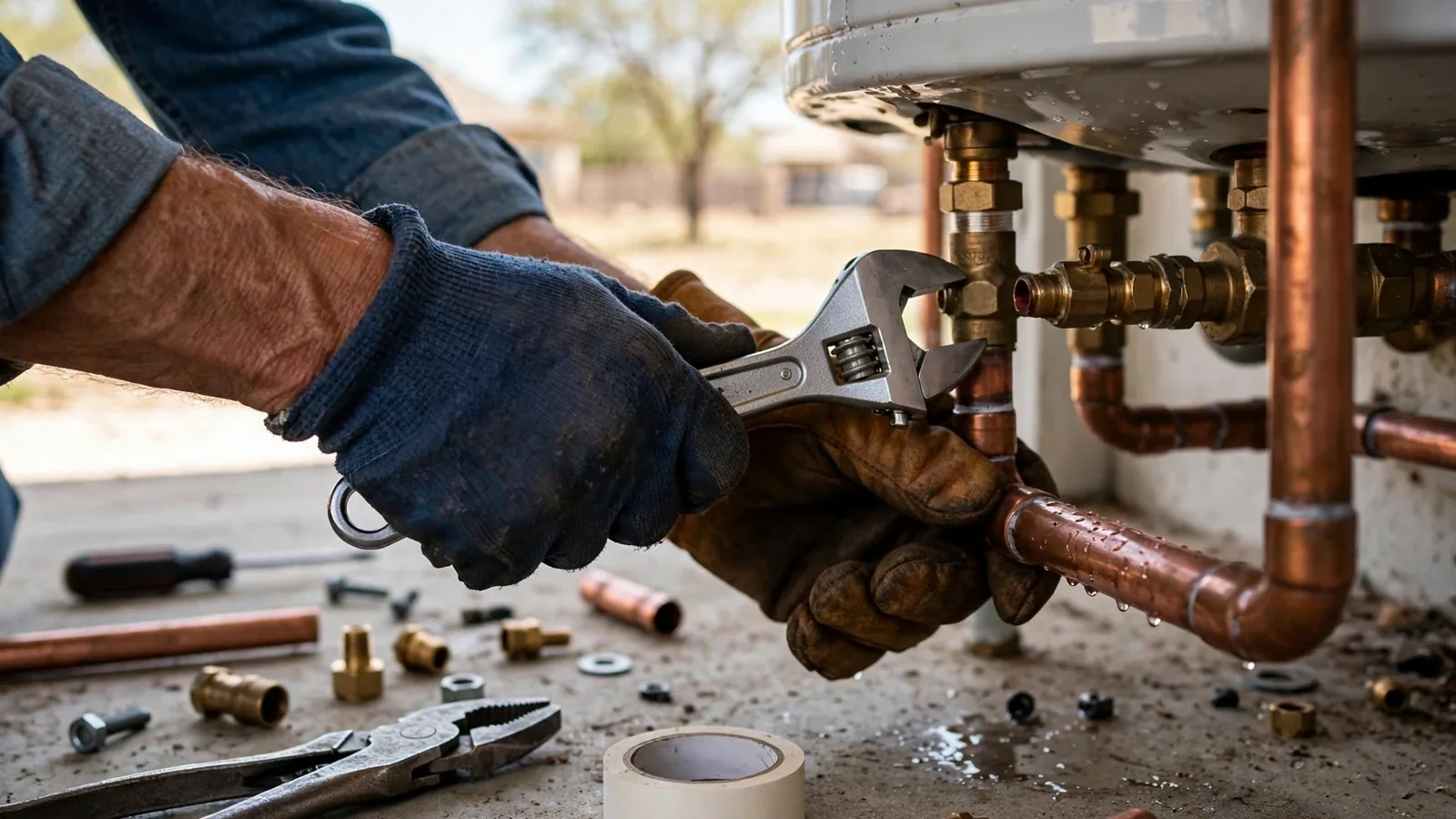
Signs an element has failed
Elements fail one at a time, so the symptoms depend on which one is dead. A tester or meter confirms it before you buy parts.
Little or no hot water
The upper element heats first and controls the whole tank, so when it dies the lower element usually stays off and the water stays cool.
Hot water runs out quickly
A dead lower element leaves only the top section heated, so the supply drains fast.
The breaker trips
A shorted element can trip the breaker as soon as the heater tries to run.
A rumbling or popping sound
Scale on an element traps water against the metal, which boils in small bursts.
If water is leaking from the tank or the pressure relief valve, the element is not the cause. See the last section before ordering parts.
Safety first: power off and test
Water heaters run on 240 volt power, which can injure or kill. Do these steps in order and do not skip the test.
- Turn off the breaker for the heater. Find the double breaker in the panel and switch it off. Tape it or tell everyone at home not to switch it on.
- Remove the access panel and insulation. Both elements sit behind metal covers, with foam insulation and a plastic safety shield behind each.
- Test at the terminals with a meter or tester. Touch a non-contact tester to the wires and then check with a multimeter. A reading of zero volts confirms the circuit is dead.
- Take a photo of the wiring. The photo shows which wire goes to which terminal and makes reassembly easy.
If you are not comfortable working near 240 volt wiring, stop here and call. Testing is cheap and a mistake is not.
Tools and parts to gather
Match the new element to the old one. The details are printed on the element or the tank label.
| Item | What to get | Why |
|---|---|---|
| Replacement element | Same voltage, wattage and mounting style | A screw-in element and a bolt-in flange element are not interchangeable |
| Element wrench | A 1-1/2 inch socket or a special tank element wrench | A regular wrench slips and damages the element |
| Gasket | New rubber gasket for the element | An old gasket leaks at the seal |
| Multimeter | Reads volts and ohms | Confirms the power is off and tests the old element |
| Hose and bucket | A garden hose to a floor drain or yard | Water from the tank can be very hot, so route it safely |
Not hot, or not sure which part failed?
Call the 24/7 line and describe the symptoms. A plumber can test the elements and thermostats and give a clear price before work starts.
Draining and swapping the element
Draining lowers the water below the element so it does not pour out when you unscrew it.
- Turn off the cold water supply to the tank. The shut-off valve sits on the cold line above the heater.
- Open a hot tap in the house. Air entering the system helps the tank drain.
- Connect a hose to the drain valve and drain below the element. For the upper element, drain a few gallons. For the lower, drain the tank fully.
- Disconnect the wires and unscrew the element. Turn the element wrench counterclockwise until it comes free.
- Clean the seat and fit the new element with a new gasket. Hand tighten, then snug it with the wrench. Do not overtighten.
- Reconnect the wires as photographed. Replace the insulation, shield and panel before turning anything on.
Refill the tank fully before the power goes back on. A heating element that runs dry can burn out in seconds.
Refilling and restoring power
Close the drain valve and open the cold supply. Leave the hot tap open until water flows steadily with no sputtering, which means air has left the tank. Check the element seal for drips, tighten slightly if needed, then turn the breaker on.
Allow the tank time to heat, which depends on its size and the water temperature. Check the hot tap again and look at the element seal one more time after it has warmed up. If it drips, power off and tighten or replace the gasket.
Swapping an element is a repair, but any change to the relief valve or discharge pipe falls under the California Plumbing Code, which is built on the Uniform Plumbing Code (UPC).
Why hard water kills elements early
Minerals in hard water bake onto the hot metal of an element and form a crust. The crust insulates the element, so it runs hotter than it should and eventually burns out. Sediment also collects at the bottom of the tank and can bury the lower element, which is why a periodic flush helps. Low watt density elements handle scale better than high density ones.
Goleta water and code notes for water heaters
Goleta Water District's 2025 water quality report gives a customer average hardness of 21 grains per gallon, which is high. That much mineral content means an element may need replacing sooner here than in softer water, and flushing the tank once a year can slow the build-up.
California Health and Safety Code section 19211 requires new and replacement water heaters to be braced, anchored or strapped against earthquake motion. An element swap does not change that, but check the straps while the panel is open. Permit rules vary, so ask City of Goleta Building and Safety or County Building and Safety for a full replacement.
Replace the element or the whole heater
An element is a cheap part. A tank is not. The decision comes down to the tank's condition.
An element swap makes sense when
- The tank is dry and has no leaks
- The heater is younger than its expected life
- Only one element tests bad
- The tank flushes clean without much rust
A tank replacement makes sense when
- Water is leaking from the tank body
- The tank is rusted at the base or seams
- Several elements have failed in a short time
- The heater is near the end of its expected life
For a tested diagnosis, our water heater repair visits check the elements, thermostats and tank. If the tank is done, water heater replacement covers the swap and the strapping.
When to stop and call
Call if the breaker trips again after the new element goes in, if the terminals look scorched, or if water is wet around the access panel. Those signs point to wiring, a thermostat or a leaking tank, not just a worn element.
Homes in Hope Ranch and Eastern Goleta Valley are served by the same 24/7 line, and a plumber will confirm the tank is safe before leaving.
Questions we hear most
Little or no hot water often means the upper element. Hot water that runs out fast usually means the lower. A multimeter set to ohms on each disconnected element confirms it.
Only for the lower element. For the upper, drain until the water level falls below the element. A hose to a floor drain makes either job easier.
A 1-1/2 inch deep socket or a dedicated element wrench. A regular wrench slips and can bend the terminal.
The element heats with no water around it and can burn out in seconds. Fill the tank and let the hot tap run steady before restoring power.
It can. Goleta Water District's customer average of 21 grains per gallon leaves scale on the element surface. Flushing the tank and choosing a low watt density element helps. A softener also helps, and our plumbers can discuss that.
Permit rules vary, so ask City of Goleta Building and Safety. A simple element swap is repair work, while a full tank replacement raises other questions, including seismic strapping.