
Two kinds of main valve
Most homes have one of two valve types. Knowing which you have tells you how to close it and how likely it is to fail.
| Valve type | Handle | How to close it | Watch for |
|---|---|---|---|
| Gate valve | Round wheel like a hose bib | Turn clockwise several full turns until snug | Old ones seize or leak at the stem |
| Ball valve | Straight lever | Quarter turn, so the lever sits crosswise to the pipe | Stiff handle from scale or disuse |
| Stop valve at a fixture | Small oval knob or lever | Turn clockwise by hand | Controls only one toilet or sink |
Where the main valve usually is
The shutoff is on the pipe where water first enters the house. In many homes that is on an outside wall near the front or side, in the garage, in a utility closet or near the water heater. In homes with a basement or crawl space it is often where the pipe comes through the foundation.
Follow the supply pipe from the front of the property toward the house. Look for a pressure regulator, a bell-shaped device on the line, since the main valve is usually just before or after it. If you still cannot find it, check around the water heater and along walls closest to the street.
The house-side valve is part of the plumbing the California Plumbing Code, built on the Uniform Plumbing Code (UPC), expects to be accessible, so a valve that is buried or seized is worth replacing.
If water is pouring right now
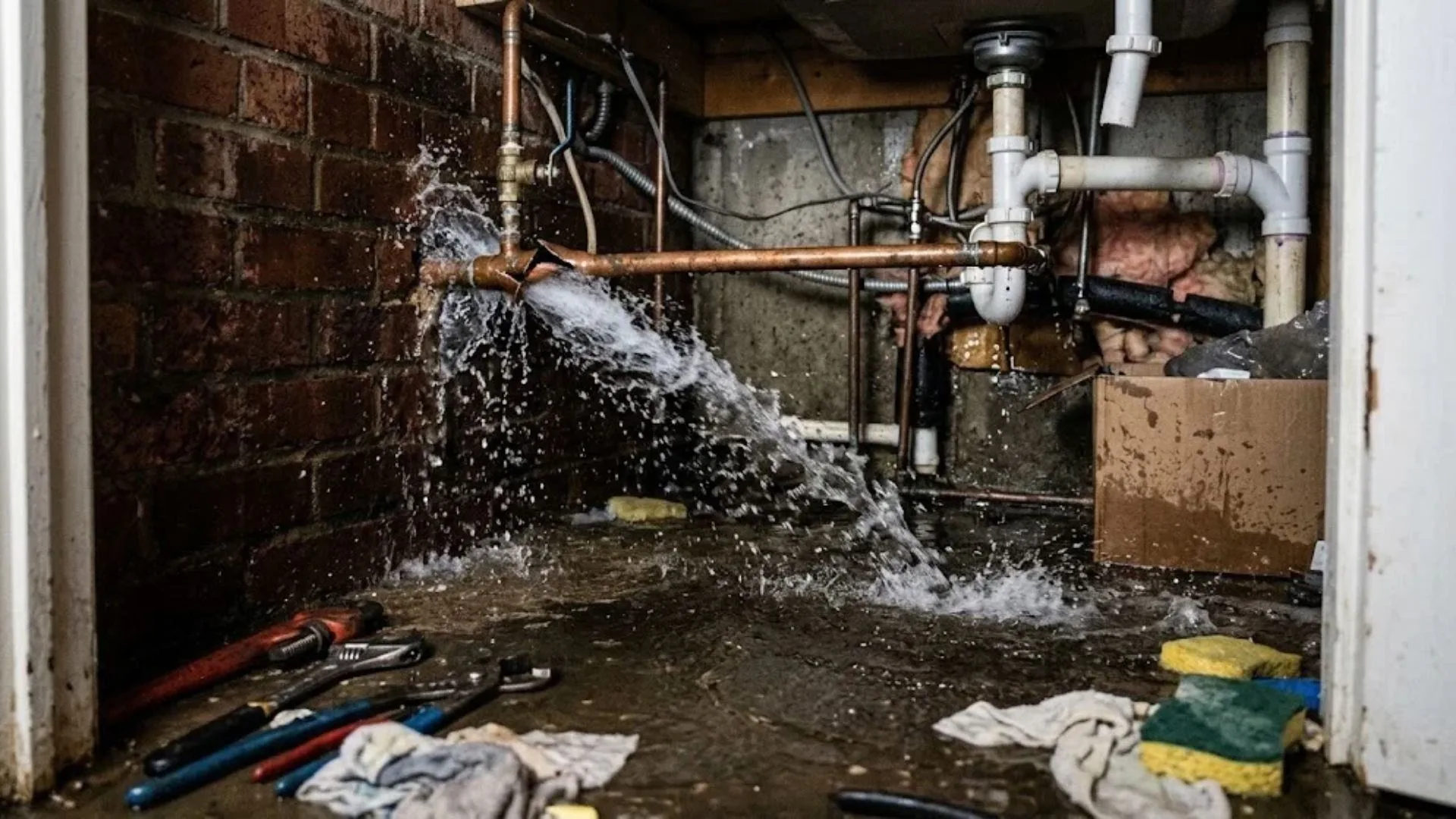
A burst pipe or failed supply line calls for speed and order. Do these in sequence.
Close the main valve
Turn it all the way off. If the water slows to a dribble, the supply is shut.
Cut the power if water is near outlets
Switch off the breaker for any wet room if you can reach the panel without standing in water.
Open a low faucet
Open a tap on the lowest floor and flush a toilet to drain the pipes and relieve pressure.
Call us
Call the 24/7 line and tell the dispatcher what burst, where the water is and whether it has stopped.
Move rugs, electronics and stored items out of the wet area while you wait. If the leak is behind a wall or under a slab, burst pipe repair starts with locating the break.
No valve you can trust?
Call and ask for a new main shutoff. We offer same-day appointments when available and give a clear price before work starts.
The valve at the meter is not yours to turn
The meter sits in a ground-level box near the curb or property line. Next to it, on the utility's side of the meter, is a shutoff that belongs to the water provider. Customers should not operate it. Turning it can damage the stem, and a damaged utility valve can leave the whole street without a shutoff.
Some meter boxes also have a second valve on the house side of the meter. Whether that one is yours to use depends on the provider and the setup, so ask your water provider before you rely on it. In a real emergency, the main valve at the house is the one to use.
How to close and test the main valve
Practice this once when nothing is wrong. A valve that has not moved in years can be stiff, and you want to learn that before a flood.
- Locate and identify the valve. Check the handle. A wheel is a gate valve and a lever is a ball valve.
- Close it slowly by hand. Do not use pliers or a wrench on a gate valve. Stop when it is firm.
- Open a faucet to confirm. The flow should die to a trickle. If water keeps running, the valve is not sealing.
- Reopen it slowly. Open the valve fully, then back it off a quarter turn on a gate valve so it does not stick.
- Tag it. Hang a tag or mark the wall so anyone in the home can find it.
Whole house shutoff or a fixture stop
Not every leak needs the main closed. Picking the smaller shutoff saves the household water for everything else.
Use a fixture stop valve
- A dripping faucet or supply line under a sink
- A toilet that is overflowing or running
- A leaking dishwasher or washing machine hose
- A leaking hose bib with its own control
Use the main valve
- A burst pipe or a gushing supply line
- Water through the ceiling or running inside a wall
- A failed water heater connection
- A leak you cannot find or reach
After closing the main, drain the lines and call. If you suspect a slow leak that comes and goes, leak detection can find the source without opening finished walls.
If the valve will not turn or will not seal
A stuck valve is a common surprise. Scale builds around the stem in very hard water, and Goleta Water District's 2025 report gives a customer average of 21 grains per gallon. Do not force a seized valve with a pipe wrench, since a snapped stem can turn a small problem into a flood.
A valve that closes but does not stop the flow is worn out. Either way, a plumber can replace it with a ball valve, which is simpler to operate. Having a reliable main valve is worth the visit.
Goleta water providers and where your valve fits
Goleta Water District serves the Goleta Valley, and its customer counter is at 4699 Hollister Ave. Ask GWD about the meter and the valve beside it, and who owns the pipe between the meter and the house, since those details were not confirmed here.
Different parts of our service area have different providers. Montecito Water District serves Montecito and Summerland, and La Cumbre Mutual Water Company serves Hope Ranch. If you live in Montecito or Hope Ranch, confirm which provider reads your meter before you go looking for its shutoff.
Questions we hear most
Close the main valve at the house, switch off power to wet areas if you can do it safely, and open a low faucet to relieve pressure. Then call the 24/7 line and describe what burst.
On a round wheel gate valve, turn clockwise. On a lever ball valve, turn a quarter turn so the lever sits crosswise to the pipe. Righty tighty is the rule for most valves.
No. The valve on the utility's side of the meter belongs to the water provider and customers should not operate it. Use the main valve at the house, and ask your provider about any second valve.
The house valve is usually where the supply pipe enters the building, wherever you live. For the meter and its valve, your water provider matters: Montecito Water District in Montecito, and La Cumbre Mutual Water Company in Hope Ranch. Check your bill to see which one applies.
The packing around the stem has worn, which is common in old gate valves. Tightening the packing nut a small amount sometimes stops it, but a plumber can replace the valve.
Check the garage, the water heater area and the exterior wall nearest the street. If it is still missing, call us. A plumber can locate it and add a new main valve.